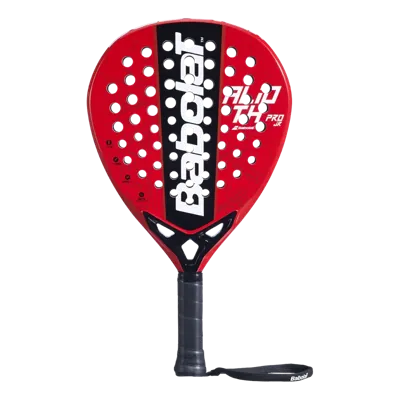
The Babolat Alioth Pro JR is a junior racket with a carbon face and frame, a teardrop shape and a fixed 330 g weight. On paper it leans towards control and comfort, not raw power. The one court test, by padel.how, backs that up. Catch: it is aimed at competitive juniors, so a first racket may not need it.
RBy Ruud Caris · facts checked 9 October 2026Choose it if
- your child is a competitive junior in the 8 to 12 age range and already plays regularly
- you want a soft EVA core and a carbon face that gives a direct response without a harsh feel
- your child wins points with placement and patience more than with big swings
Skip it if
- your child is just starting out and needs a rounder, more forgiving shape, in which case look at the Babolat Alioth JR
- you want a racket with a stated beginner or intermediate level, like the Head Speed Junior 2023
- your child is small or still building technique and has trouble with a fixed 330 g weight
How it plays
Line = the average of all rackets ▲ above ▼ below
On paper this is a control-first junior racket with a soft feel and easy handling.
- Control The soft EVA core, carbon face, teardrop shape and low balance point all push towards accurate placement, and padel.how rated control positively.
- Power Power is the weakest side here, and the reviewer called it neutral, so expect help from the carbon face but not a big gift.
- Comfort The soft core and a light weight class make it kind to a young arm, and the reviewer rated comfort positively.
- Handling A light weight class and a low balance point should make it quick to swing and to bring back into position.
- Forgiveness Medium on the meters, though padel.how described a large usable sweet spot, so the two sources lean slightly different ways.
Specifications
Not published by the brand: head size, handle
Specs from the brand's own site · checked 25 September 2026 · Spotted a wrong spec? Report it →
Price history
Lowest price per day across the shops in your market. Checked every night.
What reviewers say
Only one source has reviewed this racket so far, so there is nothing to compare it against. padel.how played it and gave 72 out of 100. It liked the clear carbon response, the large usable sweet spot and the accessible power. It marked comfort, control, grip and sweet spot as positive, power as neutral. Its one concern is limited stability against hard lateral contact. It names competitive juniors aged 8 to 12 as the target.
The product page tells a different story on power. It claims strong power and agility, while the review finds power merely neutral. Treat the review as the more grounded view, and keep in mind it is a single opinion.
A 330 g racket is a lot to ask of a young player. That is the first thing to keep in mind with the Babolat Alioth Pro JR. The weight is also fixed: Babolat lists the same minimum and maximum, so there is no range to choose from.
Carbon for a young player: what the face material changes
The face and the frame are both carbon, according to Babolat. The whole hitting area shares one material. In the review, padel.how's pros list mentions a similar point: a clear carbon response with direct attacking potential.
The core is soft EVA, listed by a retailer. A soft core should take some of the sting out of a carbon face. Together they point to a racket that responds quickly but stays kind to the arm. The surface is listed as smooth, so do not expect extra bite for spin.
The product page promises power, the meters say control
The product page makes big claims. It calls the racket one of the lightest and most powerful on the market and talks about a combination of power and agility. Treat that as marketing.
The specs and the review tell a calmer story. The soft core and the low balance point lower the power reading. The carbon face and teardrop shape raise it a little. The result on the meters is low power and high control. padel.how rated power as neutral, not strong. A retailer describes the player profile as control. So the racket suits a child who places the ball, not one who needs a bigger hit.
330 g, 255 mm, even balance: reading the numbers at junior scale
Babolat calls the balance even. The balance point is 255 mm, listed by a retailer. The meters count that as a low balance point, which helps handling and comfort. In plain terms, the weight sits towards the hand, not the head. The racket should swing fast and be easy to recover for the next shot.
Thickness is 36 mm. The head area, the handle details and the weight system are not published. That matters for a junior, because grip size is a big part of fit. Babolat's product page says the grip was adapted for young players, but gives no figures. Check the grip in a shop if you can.
72 out of 100 from padel.how: direct response, limited stability
There is one review, and the reviewer played the racket. It gave 72 out of 100. The pros: a clear carbon response, a large usable sweet spot and accessible power. The con: limited stability against hard lateral contact. The review gives no further detail on that point, so treat it as a single reviewer's note.
The same review marks grip, comfort, control and sweet spot as positive, and power as neutral. It names competitive juniors aged 8 to 12 as the target group.
Alioth Pro JR or Alioth JR: carbon and teardrop against fiberglass and round
The Babolat Alioth JR is the same-year sibling. It has a fiberglass face, a round shape, a head-light balance at 250 mm and a thinner 34 mm profile. Its weight runs from 310 g to 330 g. The meters give it high control, low power, high comfort and high maneuverability, and a high sweet spot where the Pro JR reads medium.
So the choice is clear on paper. The Alioth JR has the rounder shape and the higher sweet spot reading. The Pro JR adds a carbon face and a teardrop shape, which the review links to a more direct response.
Pro JR, Alioth JR or Head Speed Junior 2023: picking a junior racket
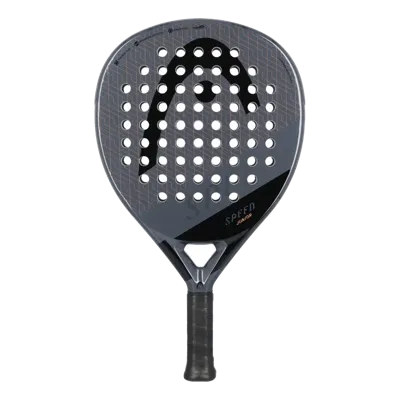
The Head Speed Junior 2023 is a teardrop with a Power Foam core and a fiberglass face. It is listed for beginner and intermediate players. Its meters read medium for control and maneuverability, against high for the Pro JR. There is a direct comparison if you want the details side by side.
A simple rule works. If your child is competitive and already hits with control, the Pro JR fits. If your child is still learning the basics, a fiberglass racket with a stated beginner level is a calmer start.
Similar rackets
Questions before you buy
Is the Babolat Alioth Pro JR good for a beginner?
It is aimed at competitive juniors aged 8 to 12, not at first-time players. The retailer profile is control and the brand gives no level. A true beginner may do better with the Babolat Alioth JR.
What is the difference between the Alioth Pro JR and the Alioth JR?
The Pro JR has a carbon face, a teardrop shape, 255 mm balance and 36 mm thickness. The Alioth JR has a fiberglass face, a round shape, 250 mm balance and 34 mm thickness. The Pro JR is also a fixed 330 g, while the Alioth JR runs from 310 g to 330 g.
Is it comfortable for a young arm?
On paper, yes. The core is soft EVA and the meters read high comfort. padel.how rated comfort positively. The 330 g weight is still a lot for a small child, so check the fit.
How does it compare with the Head Speed Junior 2023?
The Babolat has a carbon face and reads higher on control and maneuverability. The Head has a fiberglass face and a Power Foam core, and is listed for beginners and intermediates. Both are teardrop shaped.
Is the Alioth Pro JR worth the money right now?
Which shops deliver, and what shipping costs, depends on your country. The price comparison shows it for yours.
See all pricesWhat is the closest alternative?
The Head Speed Junior 2023 plays most alike. Differences: handling -3.0, control -2.5.
Compare side by side →Who should not buy it?
Skip it if you want easy power for smashes (power 4.5/10).
How heavy is it really?
The brand gives 330 g. That counts as light. Each racket can differ within that range.
Why a range? →