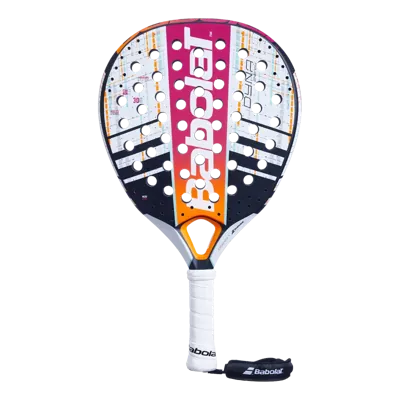
Babolat Dyna Energy
7.9padell.io scoreSpecs + 1 review source- Shape
- Teardrop
- Weight
- 330 g
- Balance
- Even
- Core
- EVA
The Babolat Dyna Energy is a 330 g teardrop with a carbon frame and a Carbon Flex face, which Babolat describes as soft and easy on the arm. The one review, from padel.how, found it comfortable and very quick to handle, but short on power. Choose it for handling and comfort. Not for finishing points.
RBy Ruud Caris · facts checked 15 October 2026Choose it if
- your arm complains after long sessions and you want a carbon racket that Babolat describes as soft
- you are a beginner or intermediate player who values quick handling and defence
- you prioritise defence and easy depth over finishing points
Skip it if
- you want a bit more power, since the Dunlop Nemesis Carbon reads Medium for power against Low here
- you hit heavy balls often and need stability on contact, since the one test flagged limited torsional stability there
- you want more control on paper, where the Dunlop Inferno Elite LT G1 HL reads High against Medium here
How it plays
Line = the average of all rackets ▲ above ▼ below
On paper this is a light racket with a comfort lean that asks you to supply the pace yourself.
- Control Medium on the sheet, though the court test rated it negative.
- Power Low, because of the light weight and the review's limited power.
- Comfort High, which is the clearest strength and the one the reviewer praised too.
- Handling Medium on the sheet, yet the court test called it exceptionally easy to maneuver and redirect.
- Forgiveness Low on the sheet, though the one test rated it neutral.
Specifications
Not published by the brand: head size, handle
Specs from the brand's own site · checked 23 September 2026 · Spotted a wrong spec? Report it →
Video reviews
1 video from an independent channel or shopPrice history
Lowest price per day across the shops in your market. Checked every night.
What reviewers say
Only one source is in so far. padel.how played the racket and rated it 71 out of 100. The reviewer wrote: "Its strongest qualities are maneuverability, defense, easy depth and comfort."
The weaker side is just as clear. Power and control were rated negative, and the listed downside was limited power and torsional stability on heavy balls. The sweet spot was rated neutral.
The reviewer points to beginner-intermediate players and those who put ultra-light handling first. That matches the comfort pitch on the product page. It does not match Babolat's claim of dynamic power. One source is thin, so look for more reviews before you decide.
The Babolat Dyna Energy is a carbon racket meant to be gentle on the arm. That is its whole pitch, and the one court test backs the comfort part. The rest of the story is what you give up for it.
Carbon without the bite: what Carbon Flex claims and what the reviewer found
The product page asks if you like carbon but find it too hard. Its answer is Carbon Flex, a face Babolat presents as softer, on a carbon frame, over an EVA core. The page also claims a very light build and softer materials that tire the arm less. Those are Babolat's words, not measurements.
The reviewer at padel.how rated comfort positive. That fits the claim. The same review rated power and control negative, and that is the part the pitch skips. Comfort and pace do not always arrive together, and here the test points to comfort.
Comfort High, power Low: reading a 330 g teardrop honestly
Babolat lists 330 g, with no range. That is the fixed weight. Babolat describes the Dyna Energy series as the lightest it has ever developed, and the profile on this page lists the weight class as light. A light racket takes less effort to swing and passes on less load to your arm. It also gives you less mass to drive the ball with.
On paper the teardrop shape and 36 mm thickness fit a racket aimed at ease rather than force. The reviewer noted limited power and torsional stability on heavy balls. Torsional stability is how well the head resists twisting when a fast ball lands off-centre. Here it is the weak point.
So you will not get free pace. If you build points patiently, that may not bother you. If you like to finish points quickly, it will.
A small contact window in a comfortable racket: the sweet spot question
The profile reads Low for sweet spot, and that sounds odd next to the comfort rating. Comfort is about shock and vibration. Sweet spot is about how much room you have for a mishit. A racket can be kind to your arm and still ask for clean contact.
The sources do not fully agree here. The profile reads Low, while the single test rated the sweet spot neutral. Head size is not published, so there is no number to settle it.
Who the quick, light handling helps, and who will want more weight
The reviewer's own pointer was beginner-intermediate players and anyone who puts ultra-light handling first. That makes sense. If you are still learning timing, a racket that comes round fast is easier to live with.
The same lightness works against stronger hitters. If you hit hard and often face heavy balls, expect limited power and stability.
The qualities the reviewer named were maneuverability, defence, easy depth and comfort. Smashes and finishing shots were not among them.
Next to the Nox AT 10 Genius Ultralight 23 and the Dunlop Inferno Elite LT G1 HL
The Nox AT 10 Genius Ultralight 23 is a teardrop with a fiberglass face. It reads Medium on power, comfort and sweet spot. Against that, the Dyna Energy reads High for comfort and Low for power and sweet spot.
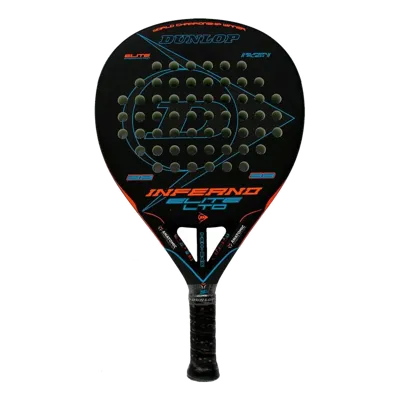
The Dunlop Inferno Elite LT G1 HL has a carbon face and a 38 mm profile, thicker than the 36 mm here. It reads High for control, Medium for power, Medium for comfort and Medium for sweet spot. Against it, the Dyna Energy reads Medium for control and Low for sweet spot.
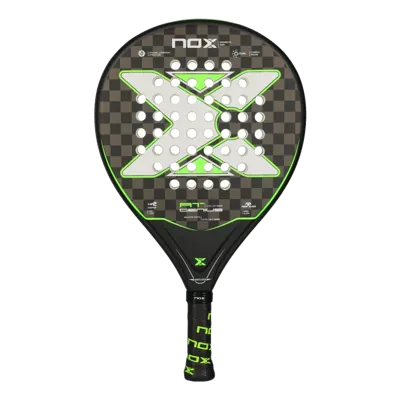
There is also the Dunlop Nemesis Carbon, which reads High for comfort like the Dyna Energy, but Medium for power. The comparison page lists the differences.
Even balance, no millimetre figure: what Babolat leaves unpublished
Babolat calls the balance even. It does not give the balance in millimetres, so you cannot place it exactly between head-light and head-heavy. The head size, the handle and the weight system are also not published. The pro player is not named either.
That matters for a buyer. Head size would tell you more about the contact window, and the handle matters for grip comfort. Check both in your hand if you can. Until then, the even balance and the light weight class in the profile are what the sheet supports, and nothing more.
Similar rackets
Questions before you buy
Is the Babolat Dyna Energy good for beginners?
The only review pointed to beginner-intermediate players. A light, comfortable racket is easy to swing. Just expect little help with power.
Does Carbon Flex make carbon soft?
Babolat says Carbon Flex is for players who find carbon too hard. The reviewer rated comfort positive, which fits. No source measured the face stiffness.
Is the Dyna Energy a good choice for a sore arm?
On paper, it points that way. It has a light weight class, an EVA core and a Carbon Flex face, and the comfort meter reads High.
How does it compare with the Dunlop Inferno Elite LT G1 HL?
The Dunlop reads High for control, Medium for power and Medium for comfort. The Dyna Energy reads Medium for control, Low for power and High for comfort. Pick the Dunlop for control, this one for comfort.
Is the Dyna Energy worth the money right now?
Today's price is labelled "Pricey today" compared with the rackets that play most alike. Which shops deliver, and what shipping costs, depends on your country. The price comparison shows it for yours.
See all pricesWhat is the closest alternative?
The Nox AT 10 Genius Ultralight 23 plays most alike. Differences: handling -1.5, comfort -1.0.
Compare side by side →Who should not buy it?
Skip it if you want easy power for smashes (power 5.0/10), or if you are still learning: it is not very forgiving (5.0/10).
How heavy is it really?
The brand gives 330 g. That counts as light. Each racket can differ within that range.
Why a range? →