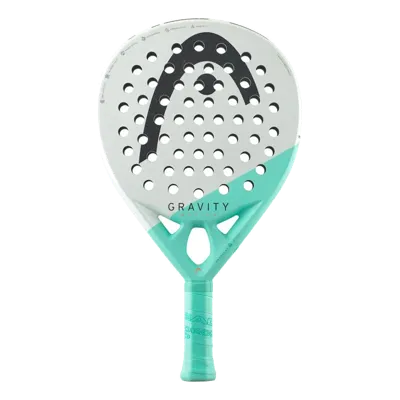
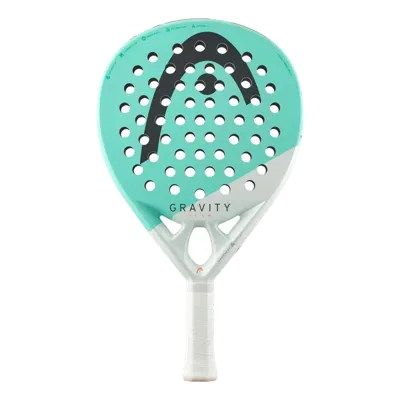
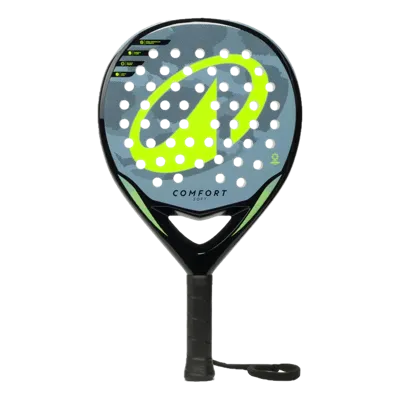
Head sells four Gravity rackets for 2024, and all four are round with a low balance and a 38 mm frame. Same shape, same recipe, different weights and faces. The Gravity Motion is the 355 g one with a full fiberglass face. It sits between the 340 g Team Light and the 365 g Pro. So the real question with this racket is not whether it plays well. It is which Gravity fits your game.
Four Gravity rackets, one round recipe
The Gravity Motion 2024 is round, 38 mm thick, with a 499 cm2 head and a low balance of 265 mm. The frame is carbon with what Head calls Auxetic 2.0, listed by shops. The face is fiberglass, the core is foam, and the surface is rough for grip on the ball.
The siblings tell you where it sits. The Head Gravity Team Light 2024 drops to 340 g and balances at 270 mm, aimed at beginner and intermediate players. The Head Gravity Team 2024 runs 360 g with the same foam and fiberglass build. The Head Gravity Pro 2024 goes to 365 g with a carbon and fiberglass face. The Motion is the middle weight with the softest face of the advanced pair.
Foam under fiberglass: comfort first, power later
The core is foam, the soft kind. The face is fiberglass, which flexes more than carbon. Together they give a soft impact and easy ball output at low and medium swing speeds. You notice that most in defense and on touch shots, where the ball leaves the face without a hard jolt.
That construction is also why the power rating sits low. Soft foam and fiberglass absorb energy instead of returning it at full swing speed. The rough surface helps you add spin on volleys and kick on overheads, which partly compensates. Not with raw pace, but with placement and effect.
355 g at a 265 mm balance: built to move
At 355 g with the balance pulled toward the handle, this racket is quick to prepare. That matters at the back glass, where you have little time, and at the net in fast exchanges. Shops list 355 g as both minimum and maximum, so on paper there is one weight, no range.
One caveat. A video review from Padel Review noted some instability during blocks. Xeexi1707 found it hard to control at very high ball speeds. That is the trade of a head-light build: fast to move, less mass behind the ball when the pace goes up. Adding lead tape to the head is the usual fix, though no weight system is published for this model.
Reviewers agree on control, split at high speed
Five sources have weighed in, and the agreement is broad. Control, comfort, a wide sweet spot and easy handling come back everywhere. Padel.how played the racket and rated it 78 out of 100. Their summary puts it plainly. "The 355 g round setup, fiberglass face and Control FOAM put quick preparation and comfortable placement ahead of a heavy finishing ball."
The split is about pace. Roberto Cardi's video test found a good balance of power and control for a wide range of players. Xeexi1707 and Padel Review both found it struggles when the game gets very fast. Padelzoom, which computes its profile from specs rather than playing, lands in the middle: positive on control and sweet spot, neutral on power.
The power ceiling, and who it bothers
Every source that tested the racket flags the same downside: limited power. Smashes need your own arm speed, and the head-light balance does not help lobs either, according to Xeexi1707. If your game ends points at the net with flat power, this racket will ask more of you than it gives back.
Who does it not bother? Players who build points. Chiquitas, bandejas with spin, low balls at the feet, defense that resets the rally. Head markets it at advanced and professional players, and Andrea Ustero plays a version from the same line on the right side. If that describes your game, the Motion is the Gravity to look at first. If you want more mass in the same mold, the Pro adds 10 g and carbon in the face, though its power rating stays low too.