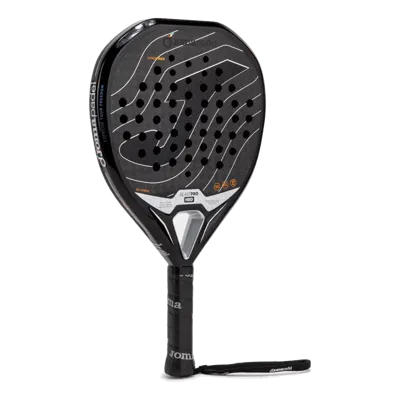
Joma's product page describes the Blast Pro HRD as a competition racket that balances control and power, with a large sweet spot and excellent manoeuvrability. The spec sheet and the meters paint a different picture. The sheet lists a high balance, a hard core and a weight of up to 370 g. Which one should you trust?
Mid-high on the page, high on the sheet: which balance to believe
The product page text says "mid-high balance". The brand's spec sheet says "high". The two disagree. Joma does not publish a balance in millimetres, so you cannot settle it with a number.
Treat it as head-heavy. The sheet is the structured source, and the other signals fit it. A head-heavy racket sends more weight into the ball. That helps overhead power, and it costs you speed when you have to react at the net.
Large sweet spot and easy to move, says the page: what the meters answer
The product page claims a large sweet spot and great manoeuvrability. The meters suggest otherwise. Maneuverability is rated low, because the weight class is heavy and the balance is high. The sweet spot is also rated low, because of the hard Black EVA core, while the tested review rated it neutral.
That does not make the claims false in every hand. But on paper, expect a racket that rewards clean contact and early preparation, not one that saves you when you are late.
The frame is called Dualtech Frame by Joma. The face is 12K carbon with the Joma 3D Spin finish, which the brand says adds effect on topspin and slice. The shape is hybrid, which usually sits between the round and the diamond: some power, some room for error. Here the hard core and the balance push it firmly toward power.
Preparing the attack: what padel.how found when it played the HRD
The only review listed is from padel.how, rating it 73 out of 100. Its pros are a high attacking ceiling with useful spin and a direct, powerful response from the high-density core. Its con is limited comfort and defensive ease with firm feedback. It rates power as positive, comfort as negative, and control and sweet spot as neutral.
Its target player is the advanced attacker who prepares well and puts overhead power first. That matches the brand's own level label of Advanced / Professional. Joma lists Alberto García Trabanco as the pro player.
One retailer describes the player profile as all-round. That sits oddly next to the other signals, so read it as a loose label, not a promise of balanced play.
Hard Black EVA under 12K carbon: what your arm takes in
Joma says the high-density BlackEVA HRD core absorbs vibrations and gives a more stable, precise impact. But a hard core is still a hard core. In the meters it lowers comfort, and a heavy, head-heavy racket adds to that.
What can you do about it? Not a lot with the racket itself. You can warm up properly and keep your technique tidy. If you already feel elbow or shoulder strain with firm rackets, this is not the one to test your arm on.
Blast Pro HRD or Dunlop FX Hybrid: a similar attacking build with more control
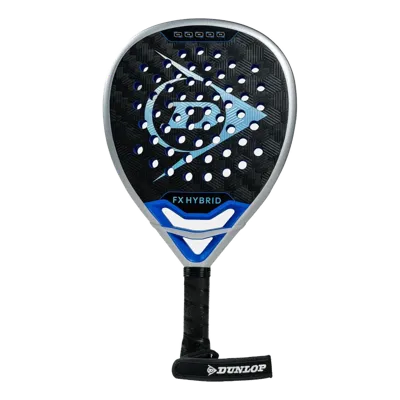
The Dunlop FX Hybrid is the closest comparison. It is also hybrid-shaped, high-balance, 12K carbon and rated Advanced, at 365 g. Its power meter is high as well. Its core is listed as EVA Pro, not Black EVA. The difference in the meters: control is medium on the Dunlop and low on the Joma. Comfort and sweet spot are low on both.
So if the attacking character appeals but you want a bit more steadiness, the Dunlop is the logical step. It is not a gentler racket, though.
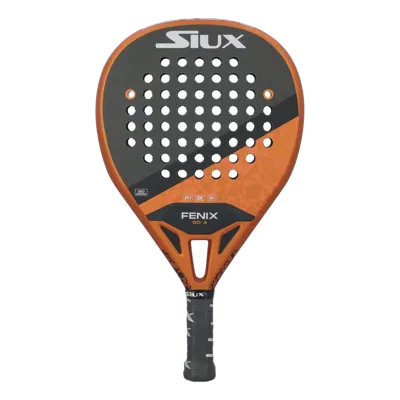
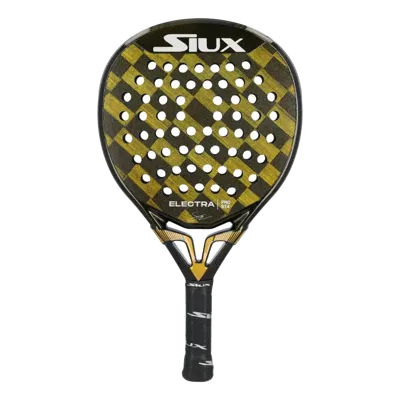
Another option is the Siux Electra Stupa Pro ST4 2025. It is listed at medium-high balance with a 15K carbon face and a hard EVA core, at 360 to 375 g. Its meters match the Joma: high power, low everything else. It is the same kind of racket, not a gentler one.
Not published: balance in mm, head size, thickness, handle, weight system
Joma does not publish several things that buyers normally check. There is no balance in millimetres, no head area, no thickness, no handle details and no weight system. The weight is given only as a range, 360 to 370 g.
The missing thickness matters most for feel, since it affects stiffness. Do not guess it. If you can, hold the racket before you commit, and check the weight on the label.