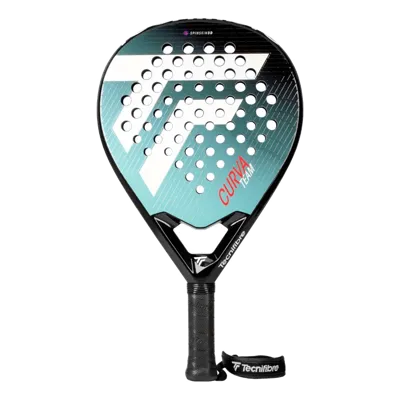
Tecnifibre Curva Team
7.7padell.io scoreSpecs only- Shape
- Teardrop
- Weight
- 345 g
- Balance
- Even
- Core
- Soft one-piece foam
The Tecnifibre Curva Team is a 345 g teardrop with a soft one-piece foam core and a carbon and fiberglass face. On paper it is a light, comfortable racket with Low power, so you make the pace yourself. No reviews exist yet, and head size and balance in millimetres are not published.
RBy Ruud Caris · facts checked 9 October 2026Choose it if
- you want a light racket that is easy on the arm and quick to swing
- you are new to padel and care more about comfort than raw pace
- you like to place the ball and build points with patience rather than hit through the opponent
Skip it if
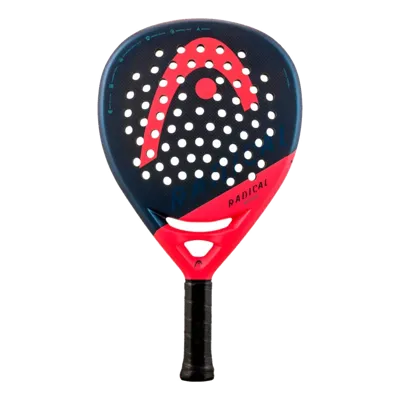
- you want more help with pace, in which case look at the Head Radical Motion 2024, which reads Medium power
- you are an advanced player, since the Dunlop Nemesis Carbon is the alternative listed for Advanced level
- you want verified numbers such as head size and balance in millimetres before you buy
How it plays
Line = the average of all rackets ▲ above ▼ below
On paper this is a light, soft, forgiving racket that asks you to make your own pace.
- Control Medium, helped by the teardrop shape, the soft core and the medium balance label.
- Power Low, because the soft foam and the light weight give little push of their own.
- Comfort High, as the soft core, the mixed carbon and fiberglass face and the low weight all point to a gentle response.
- Handling Medium, with the light weight and medium balance making it easy to move.
- Forgiveness Medium, supported by the soft core and the teardrop shape.
Specifications
Not published by the brand: head size, handle
Specs from the brand's own site · checked 30 September 2026 · Spotted a wrong spec? Report it →
Price history
Lowest price per day across the shops in your market. Checked every night.
The Tecnifibre Curva Team weighs 345 g, and that one number does most of the talking. Tecnifibre calls it the lightest racket in the Curva range for regular players. Nothing else on the sheet pushes against that.
345 g, the lightest Curva: what Tecnifibre claims and what the sheet backs up
The weight is listed as a single fixed figure: 345 g, with no range. That is light for a full-size adult racket. Tecnifibre says it suits men who want maneuverability, and also women and juniors who will be very comfortable with it. The specs agree on the light part. Both weight and the medium balance label raise maneuverability, which reads Medium. Not extreme, but easy to move.
The brand also says the frame was designed with angles to help aerodynamics and acceleration. That is a claim. You cannot check it from the numbers.
Soft one-piece foam under carbon and fiberglass: why comfort is High and power is Low
The brand lists a soft one-piece foam core. A retailer describes the density as soft too. Under a face of carbon and fiberglass, that points to a racket that absorbs shock. Comfort reads High for that reason, and the low weight adds to it.
The same soft core costs you power. The meter reads Low. A soft core and a light frame give the ball little help. You make the pace with your swing. That is not a flaw for everyone. If you want to keep the ball in play, it can be a plus. If you want easy winners from the back of the court, it is a drawback. The fix is simple: good timing and a full swing, or a racket with a firmer core.
Beginner at one shop, allround at another, Tour rackets by the brand: who is this racket for
Sources disagree here. One retailer lists the level as Beginner. Another lists the player profile as Allround. Tecnifibre says the Curva range is played by most of its Tour team and calls the rackets very maneuverable. That claim covers the range, not this model, and no pro player is named for the Curva Team.
The read from the specs: a comfort-first player who wants an easy swing suits it. If your arm is sensitive, the soft core matters more than the label.
Teardrop, medium balance, 38 mm: where the control comes from
The shape is teardrop, and the thickness is 38 mm. The balance is labelled Medium by a retailer. A teardrop usually sits between a round racket and a diamond, so it is neither pure control nor pure power. Together with the soft core, it gives Medium control and a Medium sweet spot.
The brand's surface is called Spin Skin 3D. Tecnifibre pitches the Curva line around low bounces and a negative angle. Treat that as marketing. No reviewer has tested it yet.
No review, no head size, no balance in millimetres: what you cannot check
No review of this racket was found. Everything here comes from specs and claims. Head size, handle details, the weight system and the balance in millimetres are not published. So you cannot compare its balance to a rival in millimetres. The Wilson Bela LS V3 and the Head Radical Motion 2024 both list 265 mm. The Curva Team lists a label only.
Curva Team, Wilson Bela LS V3 or Head Radical Motion 2024: picking your light teardrop
Both rivals list a teardrop shape and 38 mm thickness, the same as here. The differences come down to weight, core and face.
The Wilson Bela LS V3 reads the same on every meter: Medium control, Low power, High comfort. It weighs 355 g, against 345 g here. Fernando Belasteguin is named as its pro player. See the direct comparison.
The Head Radical Motion 2024 reads Medium power, so it gives you more help. It also weighs 355 g and has a 3K carbon face. Pick the Curva Team if you want the lightest of the three. Pick the Head if you want more power.
Similar rackets
Questions before you buy
Is the Tecnifibre Curva Team good for beginners?
On paper, yes. It is light at 345 g, soft and comfortable, and one retailer lists it as a beginner racket. Low power means you must swing through the ball yourself.
How does it compare with the Wilson Bela LS V3?
The meters read the same: Medium control, Low power, High comfort. The Curva Team is lighter at 345 g, against 355 g for the Wilson.
Is it easy on the arm?
The specs suggest so. The soft one-piece foam core, the mixed carbon and fiberglass face and the low weight all raise the comfort meter. No reviewer has confirmed it on court.
What is not known about this racket?
Head size, handle details, the weight system and the balance in millimetres are not published. The balance is only labelled Medium by a retailer.
Is the Curva Team worth the money right now?
Today's price is labelled "Fair price" compared with the rackets that play most alike. Which shops deliver, and what shipping costs, depends on your country. The price comparison shows it for yours.
See all pricesWhat is the closest alternative?
The Head Radical Motion 2024 plays most alike. Differences: handling -1.5. Today: € 129.90.
Compare side by side →Who should not buy it?
Skip it if you want easy power for smashes (power 5.0/10).
How heavy is it really?
The brand gives 345 g. That counts as light. Each racket can differ within that range.
Why a range? →