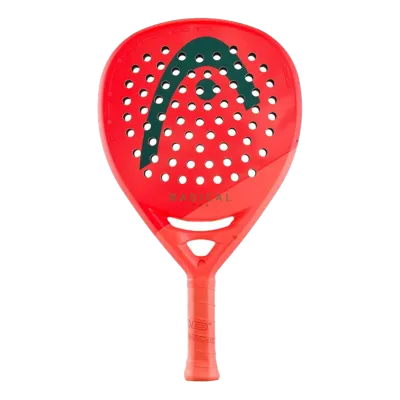
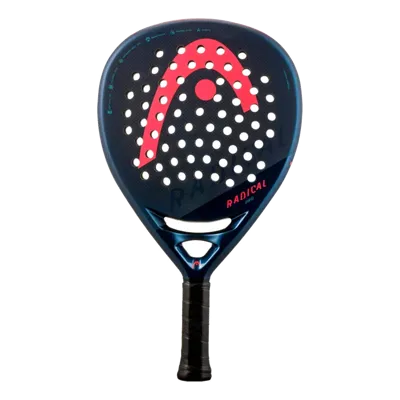
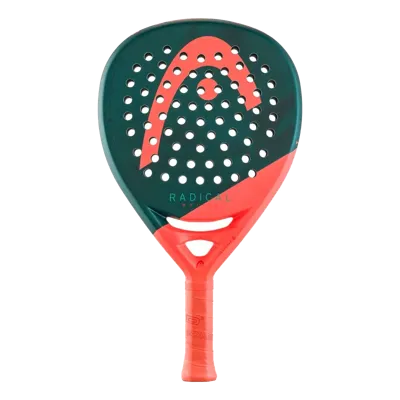
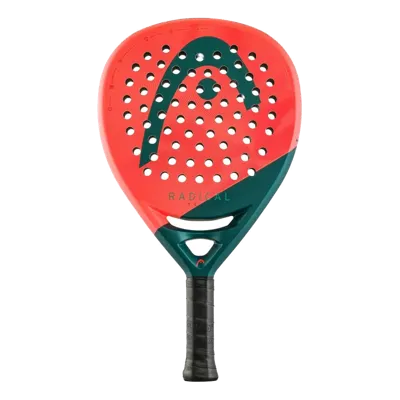
The Head Radical Pro 2026 weighs a fixed 370 g, and its product page promises improved maneuverability for net acceleration. Those two things pull against each other, and that tension runs through everything about this racket. It is a teardrop shape with a foam core and carbon faces, listed for advanced players. The specs and the one available court test point to a control racket with real mass behind it. Quick hands are not part of that picture.
370 g, take it or leave it: no lighter option in the Pro
Retailers list the same figure for minimum and maximum weight: 370 g. There is no lighter Pro. That is heavy, and it shapes how the racket plays. Mass helps you on blocks and drives, because the racket does the work when you meet the ball cleanly. It costs you in fast exchanges, where you have to move all 370 grams into position every single time. If you want the same idea in a lighter body, Head makes the Radical Motion 2026 at 355 g. That difference is not subtle.
The product page says quick hands, the meter says Low maneuverability
The product page claims improved maneuverability for net acceleration and quick transitions. Treat that as marketing, not measurement. The maneuverability meter rates this racket Low, pulled down by the heavy weight class. The balance position helps a little, but 370 g stays 370 g. The single court test on record agrees with the meter. padel.how, which actually played the racket, warns that it requires early preparation and physical strength. When the marketing and the court test disagree, trust the court test.
Foam under carbon: where the High control reading comes from
Retailers list a foam core with carbon faces. A soft foam core absorbs pace and lengthens contact with the ball, which pushes the control reading to High and lifts the sweet spot to Medium. The carbon faces add firmness, so the response stays predictable instead of vague. The trade is power: the meter reads Medium. You can hit hard with this racket, but you supply the pace yourself. The frame is listed as designed without a traditional tubular, and the product page says that expands the sweet spot. That is a claim, not a measurement.
Low on the label, 260 mm in millimetres
One retailer labels the balance Low, which suggests a head-light feel. Another retailer lists the balance at 260 mm, a figure that sits in medium territory rather than head-light. The sources do not fully agree. Read it like this: the weight sits closer to the handle than in a typical attacking racket. That helps you get the head around. But a head-light 370 g racket is still a 370 g racket. The label flatters the handling more than the scale does.
76 out of 100 from the one court test, with one warning attached
padel.how tested the racket on court and scored it 76 out of 100. The review praises net play and block stability, and describes the control as precise with a predictable response. Power, control and the sweet spot all came out positive, with grip and comfort neutral. The single warning matters more than any praise: this racket requires early preparation and physical strength. That lines up exactly with the Low maneuverability reading. Get your racket back early and it rewards you. Arrive late on a heavy ball and the mass works against you.
Pro, Motion or Team: three 2026 Radicals, one choice
Head sells four 2026 Radicals, and the naming is close enough to cause real confusion. The Pro is the heavy control option at 370 g. The Radical Motion 2026 versus this Pro drops to 355 g with a Control Foam core and rates Medium for maneuverability instead of Low. The Radical Team 2026 compared to the Pro swaps carbon for fiberglass and weighs 365 g. It rates High for comfort, with a level listing that runs from beginner to advanced. The Team Light goes further still at 340 g in a round shape. An older Head Radical Pro also has its own page, but no documented spec comparison exists for that model against this 2026 version. Same family name, four genuinely different rackets.