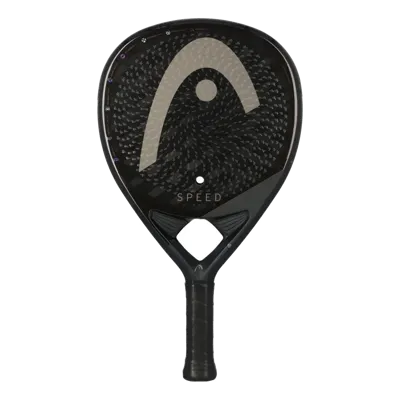
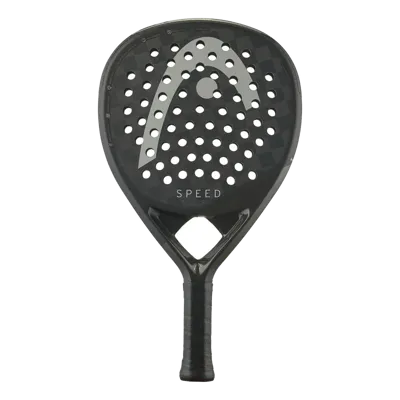
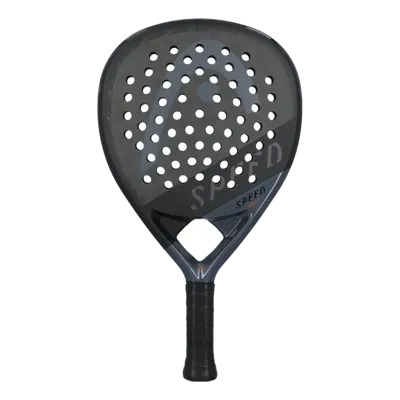
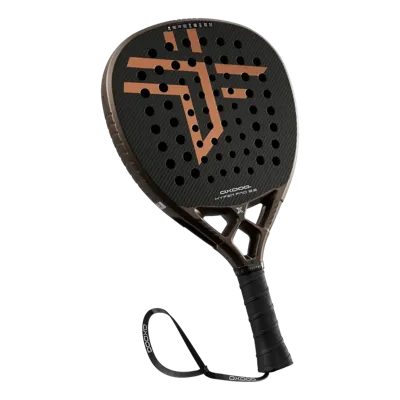
The Head Speed One X 2025 is a teardrop racket. It weighs a fixed 365 g, carries a high balance, and Head lists it at the professional level. On paper that reads like an attacking racket for players whose technique is already in place. The interesting part is how badly the two reviews on file disagree about it. They agree on exactly one thing: this racket hits hard.
One court test, one spec calculation, two different rackets
Two sources have rated the Speed One X, and they describe almost two different rackets. padel.how actually played it and gave 77 out of 100. Their testers praised a heavy, penetrating ball on volleys and overheads, but flagged late defensive contacts and recovery as demanding. Comfort and grip came out negative, control and power positive, the sweet spot neutral. Padelzoom never took it on court: its 8.5 out of 10 is computed from the specs. That calculation praises the control and even the maneuverability, plus strong power and a good sweet spot. Its one real minus is a somewhat limited ball exit speed.
Read them together and the picture sharpens. Both see the power. They split on maneuverability and the sweet spot. That is exactly where a spec sheet and a real match tend to diverge for a heavy, head-heavy racket.
365 g with a high balance: what that demands in defense
The weight is fixed at 365 g. There is no lighter version to pick. Combined with the high balance, that puts a lot of mass toward the head, and you notice it in two directions. Swing early at the net and the racket adds punch for free. Get caught late at the back glass and the same mass works against you.
padel.how's conclusion is that early preparation and clean contact stay essential, because the racket's prepared acceleration does not make difficult defense easy. That matches the meter readings, where maneuverability sits low. If your game leans on scrambling and late saves, this racket will tax that part of it. The fix, if there is one, is positioning: play a step earlier and let the weight do the hitting.
Power Foam under carbon: soft core, firm face
The core is Power Foam, a soft foam, under a carbon face with a rough surface. Retailers list the frame as reinforced with Graphene Inside, and one shop lists the head at 465 cm2. Normally a soft core means easy ball output and some built-in comfort. Here the story is different. Padelzoom found the ball exit speed somewhat limited, and the tested review rated comfort negative. The high power meter comes from the weight and the balance, not from a springy core.
The rough face is there for extra grip on the ball, which generally helps spin. Head backs that with a high spin rating of its own, discussed below.
Head's own numbers against the meters
Head's own ratings, found through a web search, are Power 10, Control 9, Comfort 9, Maneuverability 7 and Spin 10. Treat those as the brand grading its own homework. Two of them line up with independent readings. The power matches, and Head's 7 on maneuverability at least points the same way as the low meter and the court test. The 9 on comfort does not. Nobody outside Head has found this a comfortable racket, and the meter reads low there. The Spin 10 ties with Power as Head's highest self-rating. It is plausible given the rough surface, but no independent source confirms it.
Speed One X, Speed One or Speed Pro X
The closest sibling is the Head Speed One 2025, the same teardrop shape and high balance at 345 g. The product page claims the X version gains stability from the extra weight. On the meters, the lighter One reads Medium on comfort where the X reads Low. If the shape appeals but 365 g does not, that is the natural comparison.
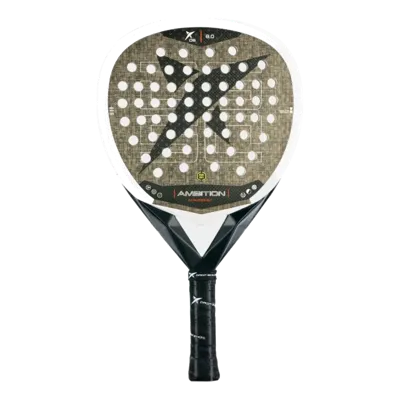
The Head Speed Pro X 2025 is the other fork. It runs 360 to 370 g with a medium-high balance. Its comfort and sweet spot both read Medium against Low here, while the power stays high. The direct comparison is worth a look if you want attacking output with less defensive cost. The Drop Shot Explorer Pro Attack Soft is a third option with a medium sweet spot, though its comfort also reads low.
The numbers Head never published
Some basics are simply not published. There is no balance figure in millimetres, so the high balance label cannot be checked against a number. The frame thickness is not published either, and neither is the handle length. A web search result lists the length at 455 mm, but that comes from a search snippet, so treat it as unconfirmed. Retailers do list a Damp Plus anti-vibration system in the bridge, which is worth knowing given the low comfort readings elsewhere. None of this stops you buying the racket. It does mean that if you like comparing balance points and beam widths across models, you cannot do that here.