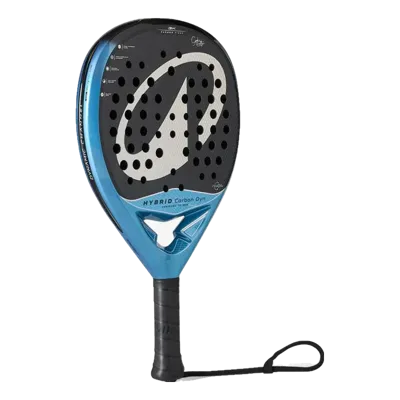
The Kuikma PR Hybrid Carbon Dynamic is a teardrop racket with a 3K carbon face over a medium EVA core, fixed at 355 g. Kuikma labels it Professional and calls the profile Polyvalentie, an all-round intent. On paper the meters land on Medium almost everywhere, with Low maneuverability. The catch: the balance is not published, and no independent review has tested it yet.
RBy Ruud Caris · facts checked 30 September 2026Choose it if
- you want one teardrop racket that does a bit of everything rather than specialising
- you already know 355 g suits your arm and do not need a weight range
- you trust a spec sheet more than marketing and accept that no court test exists yet
Skip it if
- you need to know the balance in millimetres before you buy, because Kuikma does not publish it
- you want quick reactions at the net, where the Head Radical Motion 2024 rates better on maneuverability
- you want more power from a teardrop, where the Siux Pegasus Revolution 3K rates High
How it plays
Not enough specs yet for a play profile.
- Control The teardrop shape and medium EVA core point to Medium control, enough for placement without a purely defensive character.
- Power The teardrop shape gives some help on smashes, but the meters stay at Medium, so you supply most of the pace yourself.
- Comfort A medium EVA core and a 3K carbon face suggest Medium comfort, decent absorption without a soft, dampened feel.
- Handling This is the weak meter on paper, rated Low, so expect slower handling in fast exchanges at the net.
- Forgiveness The teardrop shape keeps the sweet spot at Medium, more forgiving than a diamond, less than a round racket.
Specifications
Not published by the brand: balance, thickness, head size, surface, handle
Specs from the brand's own site · checked 26 September 2026 · Spotted a wrong spec? Report it →
The price is followed as soon as a shop in your market sells it.
Polyvalentie. That is the single word Kuikma uses for the PR Hybrid Carbon Dynamic, a teardrop racket. All-round, in other words. That one word is the whole pitch, because there is no independent review to quote and no balance figure to lean on. What you get is a spec sheet, and the spec sheet tells a fairly clear story.
Polyvalentie and Professional: Kuikma's own two words
Kuikma gives this racket two labels. The level is Professional. The player profile is Polyvalentie. Those two pull in slightly different directions. Professional suggests a demanding racket for strong players. Polyvalentie suggests a racket that adapts to many situations instead of forcing one style.
Read together, they describe an all-round racket aimed at experienced players, not a specialist weapon. The meters agree. Control, power, comfort and sweet spot all sit at Medium. Nothing is extreme. That is the point of the design, at least on paper.
If you are an improving player, treat the Professional label with some care. It is the brand's own claim, not a measured fact.
Fixed at 355 g: one weight, no choice
The weight is 355 g. Not a range, a single figure. Kuikma lists 355 g as both the minimum and the maximum.
That is a middle weight for an adult racket. Heavy enough for stability on hard hits, light enough that most regular players can handle it. But it removes a choice you often get elsewhere. Many rackets come in a range, say 355 to 375 g, so you can pick your end. Here you take 355 g or you look at another model.
If you know 355 g works for you, that is fine. If you usually play heavier for extra punch, this racket will not give you that option.
3K carbon over medium EVA: where the Medium meters come from
The face is 3K carbon. The core is EVA, rated as a medium foam in the profile. The frame mixes 70% carbon with 20% EVA and 10% fiberglass, according to Kuikma.
That combination explains the meters. A medium EVA core absorbs some impact and returns some energy, which keeps both comfort and control at Medium. The 3K carbon face adds firmness without going to the hardest weaves. The teardrop shape then lifts control, power and sweet spot to Medium each.
Nothing here is exotic. It is a familiar recipe, and familiar recipes tend to behave predictably. Not a racket built around one trick, but a balanced construction.
Low maneuverability on a teardrop: the missing balance in millimetres
One meter drops below the rest: maneuverability, rated Low. For a teardrop at 355 g, that is unexpected.
Here is the honest problem. Kuikma does not publish the balance, neither as a label nor in millimetres. Balance is the single biggest driver of how fast a racket moves through the air. Without it, you cannot say exactly why the handling rates Low, and you cannot verify it either.
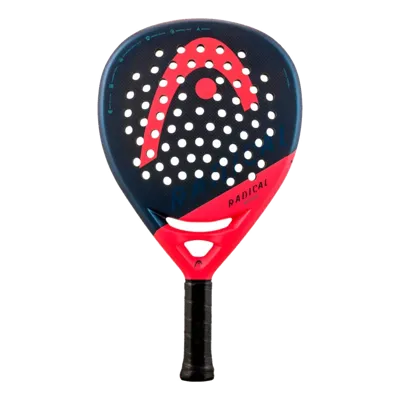
What can you do? Take the Low rating as a warning for fast net play and quick defensive reactions. If your game lives on reflex volleys, look at the Head Radical Motion 2024. It is also a teardrop at 355 g. It rates Medium on maneuverability and High on comfort.
No court test published: the spec sheet is the whole argument
No independent reviewer has published a test of this racket. No video review, no player thread worth quoting, nothing. Everything in this article comes from Kuikma's own specifications and what those specs typically mean on court.
That matters for how you read the meters. They are calculated from the construction, not measured in play. A medium EVA core usually feels a certain way. A teardrop usually behaves a certain way. Usually is doing real work in those sentences.
The upside is that the construction is conventional, so the predictions are relatively safe. The downside is that surprises, good or bad, only show up when someone plays it.
PR Hybrid Carbon Dynamic, Air Veron 2.6 or Pegasus Revolution 3K: picking a teardrop
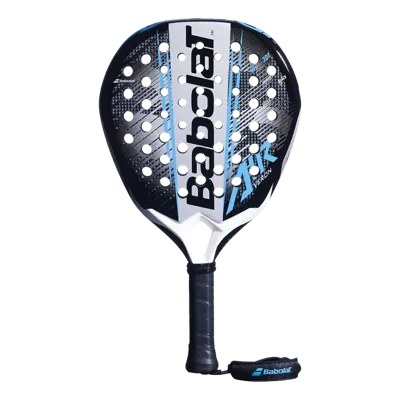
Within the teardrop category, the choice depends on what you want to trade. The Babolat Air Veron 2.6 matches this racket at 355 g and rates Medium on maneuverability, but drops to Low on comfort. You gain handling, you lose cushioning.
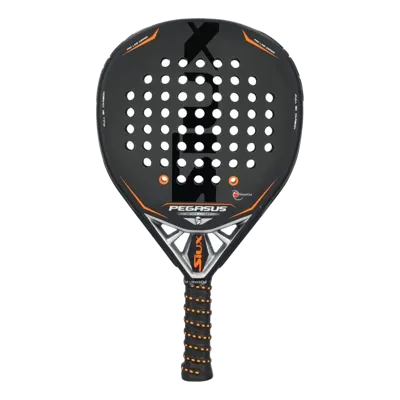
The Siux Pegasus Revolution 3K goes the other way. It has a high balance, runs from 355 to 375 g and rates High on power, with the same Low maneuverability. You gain punch at the top, you carry more weight toward the head.
The Kuikma sits between those two ideas. Medium almost everywhere, one fixed weight, and a balance figure you simply have to accept as unknown.
Similar rackets
All rackets that play like the Kuikma PR Hybrid Carbon Dynamic →
Questions before you buy
Is the Kuikma PR Hybrid Carbon Dynamic good for beginners?
Kuikma labels it Professional, and the meters show Low maneuverability. That combination points away from beginners. If you are starting out, a round racket with easy handling will forgive more mistakes.
What is the balance of the PR Hybrid Carbon Dynamic?
Kuikma does not publish the balance, neither as a label nor in millimetres. With the shape and weight alone there is no reliable way to pin it down, so it stays unknown until Kuikma publishes it.
How does it compare to the Siux Pegasus Revolution 3K?
Both are teardrop rackets with 3K carbon faces and Low maneuverability. The Pegasus runs heavier, up to 375 g, with a high balance and High power. The Kuikma is fixed at 355 g and stays at Medium power.
Is 355 g the only weight available?
Yes. Kuikma lists 355 g as both the minimum and maximum weight, so there is no lighter or heavier option within this model.
How heavy is it really?
The brand gives 355 g. That counts as medium. Each racket can differ within that range.
Why a range? →