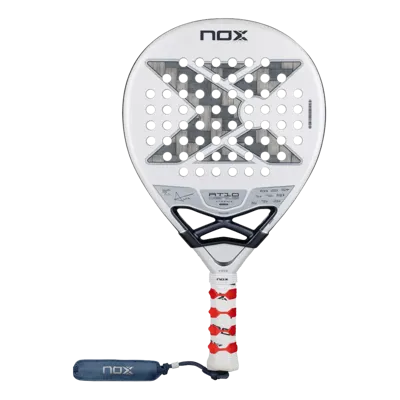
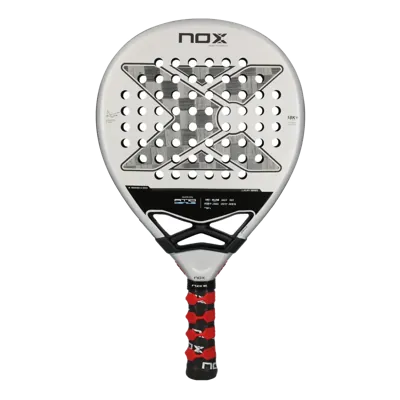
Nox AT10 Luxury Genius 12K Alum Xtrem LITE 2026
7.6padell.io scoreSpecs only- Shape
- Teardrop
- Weight
- 355 to 365 g
- Balance
- Even
- Core
- HR3 White EVA
This is the lighter version of Nox's Tapia-linked teardrop. It has 12K Alum Xtrem carbon, a 38 mm profile and a frame of 355 to 365 g. On paper it gives you high power and medium handling. The catch is that comfort and sweet spot both stay low, so your arm and your timing need to be ready. No reviews exist yet.
RBy Ruud Caris · facts checked 8 November 2026Choose it if
- you want a power-oriented teardrop but find the standard 12K Alum XTREM, listed at 360 to 375 g, too heavy
- you already hit cleanly and want a carbon face and hard core that raise power on paper
- you want medium handling in a teardrop, like its Tapia twin, and accept low comfort
Skip it if
- you need a soft, forgiving frame for sore arms, where the Nox AT10 Genius Ultralight 26 is rated High for comfort against Low here
- you are new to padel and want a wide margin for off-centre hits
- you want a heavier frame with more mass behind the ball, such as the Nox AT10 Genius 12K Alum XTREM 2026
How it plays
Line = the average of all rackets ▲ above ▼ below
On paper this is a hard, fast teardrop that is easier to move than its heavier sibling.
- Control Medium, because the stiff carbon face, teardrop shape and medium balance all raise it.
- Power High, as the hard HR3 White EVA core, carbon face and teardrop shape all add pace.
- Comfort Low, since both the hard core and the stiff face lower it.
- Handling Medium, helped by a medium balance and a frame that is lighter than the standard version.
- Forgiveness Low, because the hard core lowers it and only the teardrop shape lifts it.
Specifications
Not published by the brand: head size, handle, frame
Specs from hollandpadel.com · checked 30 September 2026 · Spotted a wrong spec? Report it →
Price history
Lowest price per day across the shops in your market. Checked every night.
Lighter is not the same as softer. The Nox AT10 Luxury Genius 12K Alum Xtrem LITE 2026 shows why. Its frame is lighter than the Nox AT10 Genius 12K Alum XTREM 2026, yet the core is still hard. No reviews exist for it yet, so everything below comes from the specs.
Lite against the standard 12K Alum XTREM: a lighter frame and a White core
The numbers first. This racket is listed at 355 to 365 g. The standard Nox AT10 Genius 12K Alum XTREM 2026 is listed at 360 to 375 g, with an HR3 Black EVA core. Here the core is HR3 White EVA.
The face is the same family: 12K Alum Xtrem carbon. The shape is the same teardrop and the thickness is the same 38 mm. So the listed differences are the weight range and the core name, HR3 White against HR3 Black. No source states a difference in hardness between the two.
What do you notice? A lighter frame is quicker to bring around for a volley or a block. Handling is rated medium here and low on the standard version. That is the practical gain.
Any level on one sheet, Professional on its twin: how to read the label
One retailer lists this racket as Any level. The twin, the Nox AT10 Genius 12K Alum XTREM Lite 2026 by Agustín Tapia, is listed as Professional. The listed specs for both are the same: 355 to 365 g, HR3 White EVA, teardrop, 38 mm, medium balance.
So the level labels disagree, and the hardware does not. Treat a level label as a shop's opinion. It is not a measurement.
On paper, the stiff face and hard core make this a racket that rewards clean contact. Any level can pick it up. That does not mean any level will find it easy.
Why medium handling arrives but comfort stays low
The handling meter has one driver: the medium balance. The balance is listed as medium, and that sets the label.
Comfort is a different story. Two things lower it: the hard HR3 White EVA core and the carbon-stiff 12K Alum Xtrem face. Less weight in the frame does not change either of them.
What can you do about it? If your elbow or wrist is sensitive, be careful. Choose it only if your arm tolerates stiff rackets, or try it before you commit.
Comfort and control, says the page: what the meters show instead
The product page makes bold claims. It says the 2026 version feels more refined, faster and more stable than earlier versions. It also says you lose nothing in comfort or control.
Those are the brand's or a shop's words, not test results. The meters tell a more careful story. Control is rated Medium, with the face, shape and balance all raising it. Comfort is low. Sweet spot is low too, because the hard core lowers it and only the teardrop shape lifts it.
The page also describes the racket as aimed at players who want power, control and agility together. On paper, power and agility fit. Control is rated Medium. Comfort does not fit the claim.
Luxury Lite, Drop Shot Axion Attack 1.0 or Conqueror Attack 1.0: three teardrops, one with lower handling
The closest rivals share the pattern: teardrop shape, medium balance, high power, low comfort, low sweet spot.
The Drop Shot Axion Attack 1.0 uses a 24K carbon face and an EVA Pro High Density core, at 360 to 370 g. That is a 5 g higher range than here. Its handling is rated low, against medium here. That is the one meter where it differs.
The Drop Shot Conqueror Attack 1.0 has the same type of build. It is listed at 350 to 370 g and as Advanced, with medium handling like this racket.
The choice is therefore mainly about handling and weight, not about a different type of racket. The Axion has the higher weight range and low handling. The Conqueror has medium handling and a wider weight range.
Weight Balance System and no court test: what is left to find out
A retailer lists a Weight Balance System. The product page claims it lets you set the balance as you like. No detail on how it works is published, so take it as a claim.
The rest is simply untested. No source has played this racket and rated it. No source describes how the face reacts on specific shots, how harsh it feels after a long session, or how big the usable hitting area is. The surface is listed as Dual Spin, but no source says how much spin you will actually get.
Until reviews arrive, the specs are your guide. They point to a fast, hard racket with a small sweet spot that is lighter than its standard sibling.
Similar rackets
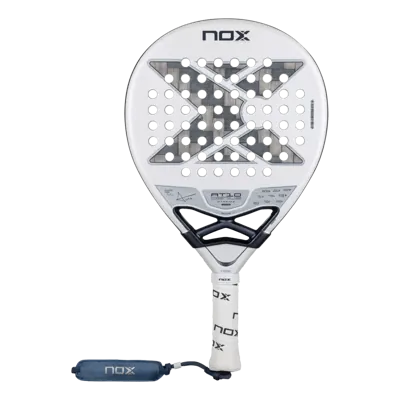
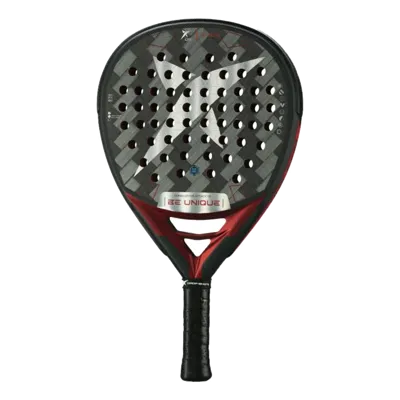
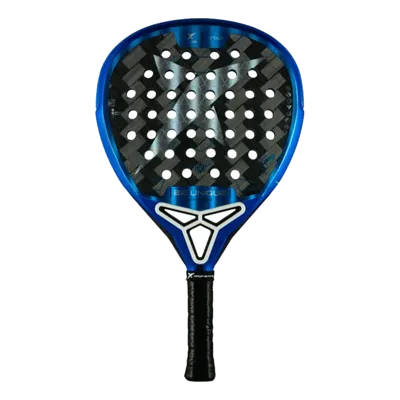
All rackets that play like the Nox AT10 Luxury Genius 12K Alum Xtrem LITE 2026 →
Questions before you buy
What is the difference between this racket and the Nox AT10 Genius 12K Alum XTREM Lite 2026 by Agustín Tapia?
On paper, nothing in the listed specs: both have 355 to 365 g, HR3 White EVA, a teardrop shape and 38 mm. The names and the level labels differ, with Any level here and Professional on the twin. A different label is not a measured change.
Is it lighter and softer than the standard 12K Alum XTREM?
Lighter, yes: 355 to 365 g against 360 to 375 g. Softer, no. Comfort is rated low on both, because the core is hard and the carbon face is stiff.
Is it suitable for beginners?
One retailer says any level, but the specs say otherwise for most beginners. The sweet spot is low and comfort is low. The Nox AT10 Genius Ultralight 26 is listed for beginners and intermediates and is rated High for comfort.
Is it kind to the arm?
Not on paper. The hard HR3 White EVA core and the stiff 12K Alum Xtrem face both lower comfort. If you have elbow or wrist trouble, test it first or choose a softer racket.
Is the AT10 Luxury Genius 12K Alum Xtrem LITE 2026 worth the money right now?
Today's price is labelled "Fair price" compared with the rackets that play most alike. Which shops deliver, and what shipping costs, depends on your country. The price comparison shows it for yours.
See all pricesWhat is the closest alternative?
The Nox AT10 Genius 12K Alum XTREM Lite 2026 by Agustín Tapia plays most alike. On paper the differences are under one point. Today: € 196.65.
Compare side by side →Who should not buy it?
Skip it if your elbow or shoulder complains (comfort 2.5/10), or if you are still learning: it is not very forgiving (5.0/10).
How heavy is it really?
The brand gives 355 to 365 g. That counts as medium. Each racket can differ within that range.
Why a range? →