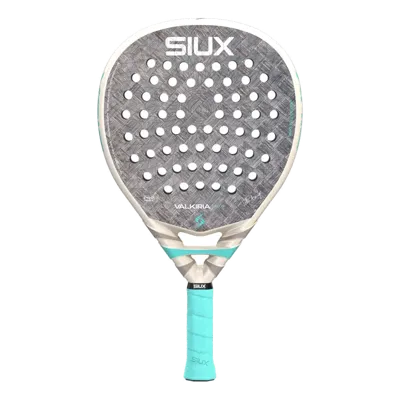
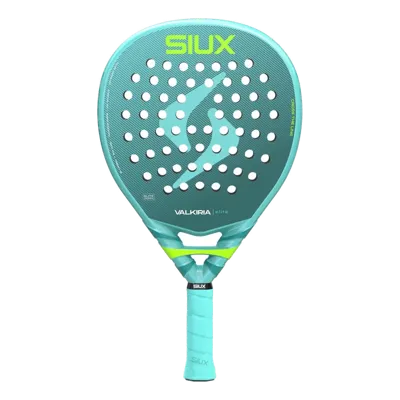
A professional label can make you expect a heavy racket built for smashes. The Siux Valkiria Pro 2026 does not read that way. It is listed at 340 to 360 g with a soft core. The one court test that rated it gives it 90 out of 100 for all-court play. So the useful question is not how hard it hits, but what kind of player it suits.
A pro racket that reads as control: Sofía Araújo's Valkiria on paper
Sofía Araújo plays this exact model, and she plays on the left. The retailer listing calls the level professional. The product page claims an "exceptional balance" between power, control and comfort. That is marketing, so look at the specs instead.
The specs say teardrop shape, medium balance, soft EVA core, carbon face. That mix points to a racket you steer, not one you swing like a hammer. Control comes out High. Power comes out Medium.
24K face, 3K frame, soft EVA: why control is High and power stays Medium
The face is 24K carbon. The frame is 3K carbon. The core is soft EVA. The surface is listed as rough matte 3D.
A carbon face is stiff. That adds some power and precision. A soft core pulls power down, but it adds comfort. The teardrop shape keeps the sweet spot reasonably central without turning the head into a diamond.
So the two pull against each other. The result is a racket that gives you something back from the face, yet is not built like a hard, head-heavy design. Not a weapon for flat smashes. A tool for placing the ball.
340 to 360 g and a medium balance with no millimetre figure: what you cannot check
The weight range is 340 to 360 g. That is light for a professional racket, and it is why maneuverability is Medium and comfort gets a lift. Fast exchanges at the net should be easy to handle.
Now the gaps. The balance is only labelled "Medium". The balance in mm is not published. Head size is not published. Thickness is not published. A weight system is not published either.
What can you do? Hold one in a shop or try a demo before you commit. The listed range is a spread, so two rackets can differ in weight. Ask for the exact weight of the one you buy.
90 out of 100 from Padelvergleich and a video review: where the sources agree and where they don't
Padelvergleich played it and rated it 90 out of 100. It praises the teardrop shape for working at the net and the baseline. Its one con is less maximum power than pure diamond-shaped offensive rackets.
A video review from Dani 13, a partial match for this racket, praises handling and control in fast exchanges. It also notes less rebound than the Adidas Cross It Light and no textured surface for spin. That last point sits oddly with the rough matte 3D surface in the listing. Treat it with care.
Valkiria Pro next to the Valkiria Elite 2: same shape, more comfort, less power
The Siux Valkiria Elite 2 is a same-year sibling. It shares the teardrop shape, soft EVA core and medium balance, and has the same 340 to 360 g range. Its face is 3K carbon. On the meters it comes out Low for power, High for comfort and Medium for control. The Pro shows High control and Medium power. If you want the gentler of the two, look at the Elite 2. If you want a little more edge, stay with the Pro.
Valkiria Pro 2026, Wilson Bela LT V2.5 or Babolat Air Viper 2.6: picking your teardrop
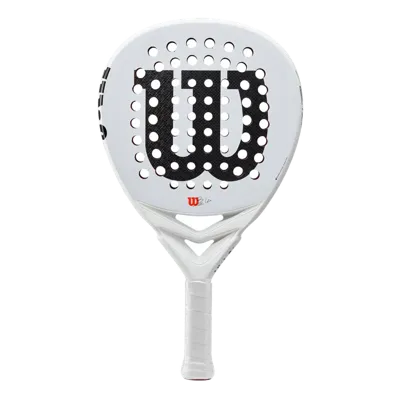
The Wilson Bela LT V2.5 is the closest match on the meters: High control, Medium power, Medium comfort. It is a 2024 racket at 355 g, with a soft EVA core.
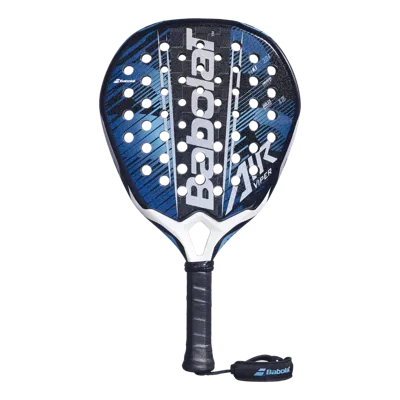
The Babolat Air Viper 2.6 goes the other way. Power is High, but comfort and sweet spot are Low. It suits a player who wants more punch and accepts a smaller margin for error.
The Valkiria Pro sits between them. More forgiving than the Air Viper, with more power than the Elite 2.