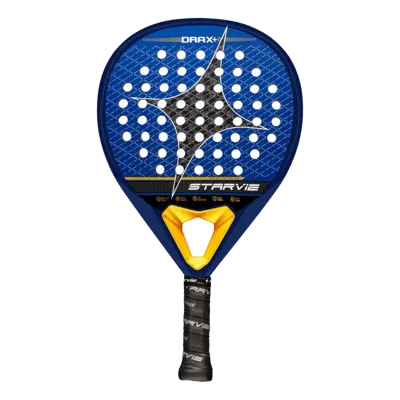
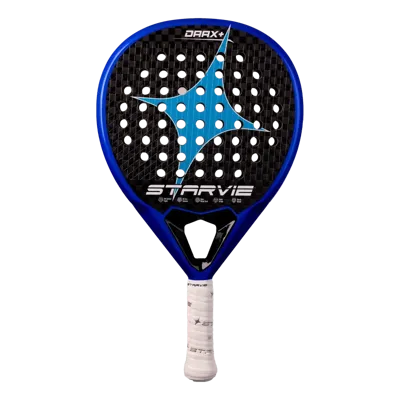
A racket listed for beginners and intermediates, yet with a Low comfort meter: that is the first thing to sort out on the StarVie Drax + 2026. The listing gives a teardrop shape, a medium balance label, 38 mm thickness and 360 g. Comfort is the odd one out, so this page spends time on it.
Quick hands, broad sweet spot: what the one court test says
Only one source has played this racket: padel.how, which gives it 74 out of 100. It rates the sweet spot and grip as positive. Power, comfort and control come out neutral. It names intermediate all-court players who want quick handling and strong spin access as the target.
That is a useful picture, but a thin one. One test is one opinion. Read it as a good sign for a broad sweet spot and quick handling, not as proof of anything else.
Beginner or intermediate: what a fixed 360 g means
The weight is listed at 360 g, with no range. That is a mid-range weight, and the listing allows no closer comparison than that.
The balance is only given as the label Medium. That suggests the racket is neither head-heavy nor head-light. It does not tell you how it swings, because no balance in mm is published.
No weight system is published either. So you cannot tell whether the weight can be tuned. The listing says 360 g, and that is what you hold. For a newer player that is simple: there are no settings to choose between.
Shock Shield and a longer handgrip against a Low comfort meter
The frame is listed as Shock Shield and the handle as a longer handgrip. The product page says Shock Shield reduces vibration. Treat that as the brand's claim, not a measurement.
The meter tells a different story. It reads Low, and the data says reviews pull it down, even though the EVA core pushes it up. Yet the one tested review rated comfort neutral, not bad. So the sources do not fully agree.
What should you do? If you have had arm trouble, try the racket before you commit, if a shop lets you. A Low meter is a warning sign, not a verdict on your arm.
Drax + 2026 or Drax +: why the 2027 racket is listed differently
The names look like one racket in two years. The listings say otherwise. The 2026 racket is listed for beginner and intermediate players. The 2027 Drax + is listed for intermediate players only. Its core carries a different name, M-EVA Balance. Its face is called 12K Carbon Hyper, its surface is listed as Rough instead of 3D, and its weight range is 350 to 370 g.
The link between the two is doubtful, so do not read this as a neat update story. Check the exact name and year on the listing before you compare them.
Next to the Astrum + 2026 and the Raptor+: where the meters rise
The StarVie Astrum + 2026 is also a medium-balance teardrop with a 12K carbon face and 38 mm thickness. It is listed for advanced and professional players. Its control meter reads High and its comfort meter reads Medium, one step higher than this racket on both.
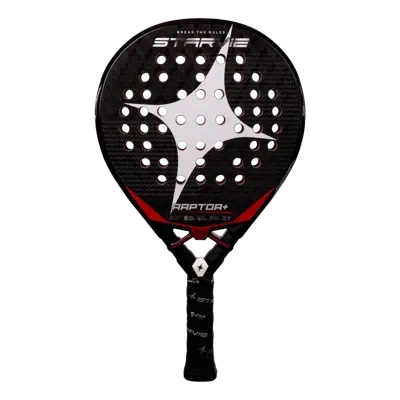
The StarVie Raptor+ is listed at professional level. Same picture: control High, comfort Medium.
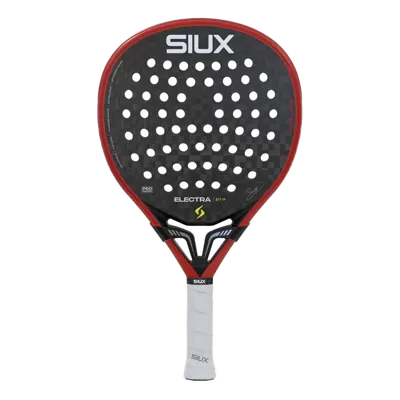
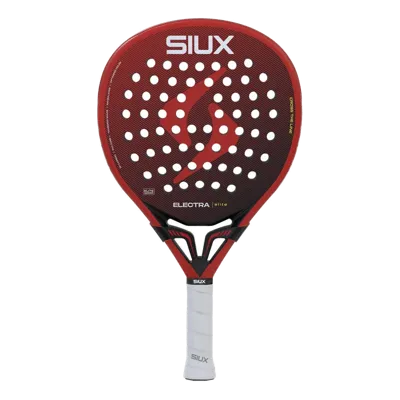
The Siux Electra Pro 2026 is another teardrop in this company, also listed for professionals. Its control meter reads High, but its comfort meter reads Low, like this Drax, and its maneuverability reads Low.
The pattern is plain. If you want higher control and comfort meters, the Astrum + and the Raptor+ show them on paper. They are also listed for higher levels. This Drax is listed for beginners and intermediates.
Balance in mm, head size, weight system: what is not published
Three specs are missing: balance in mm, head size and weight system. Balance is only given as the label Medium. That is enough to say the racket is neither head-heavy nor head-light, but not enough to compare it closely with a rival.
No pro player is published for it either.
What this means for you: judge it on the shape, the 360 g and the one court test. If a shop lets you try it, check for yourself how it handles at the net and how your arm reacts after a long session.