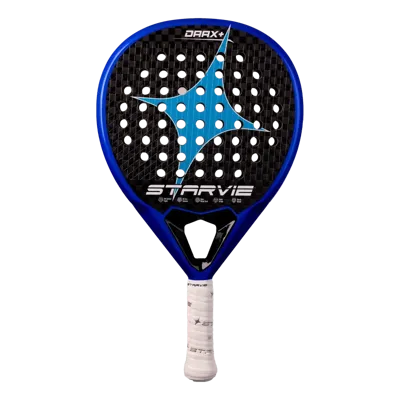
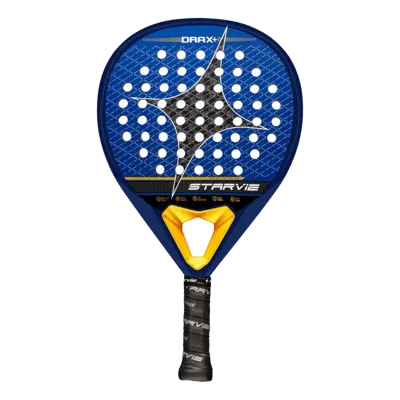
Nobody has published a court test of the StarVie Drax + yet, so the sheet has to do the talking. It says teardrop, medium balance and 38 mm thickness. Treat everything below as what the specs suggest, not as something a reviewer has felt.
What a teardrop without extremes asks of you
The label from a retailer, padelmarket.com, is Intermediate. The meters are calculated from the specs and are consistent with an intermediate label. Control is high. Power, comfort, maneuverability and sweet spot all sit at medium.
That is a calm profile. Not a racket that does one thing loudly, but one without a clear weak spot on paper. The teardrop shape and the medium balance point toward a middle-of-the-road racket, neither head-heavy nor head-light.
StarVie describes the player profile as versatile. That fits the sheet. It is still the brand talking.
350 to 370 g: a range, not a number
StarVie lists a minimum of 350 g and a maximum of 370 g. That is a 20 g window, and it matters, because the sheet does not say which weight you will get.
If weight matters to you, check the actual figure on the scale before you play, or ask the shop. Do not assume the middle.
Drax + or Drax + 2026: why the old listing may be a different racket
The 2026 listing looks like the predecessor, but it probably is not. It carries a different level label (Beginner / Intermediate), an EVA core and a fixed 360 g. Its face is listed as 12K carbon, against 12K Carbon Hyper here. The surface is listed as 3D, while this racket is listed as Rough.
A changed label is just a changed label. Do not read it as a measured improvement. If you are comparing, open the 2026 page and compare the specs yourself, rather than trusting the shared name.
Same core and weight window as the Raptor+, a different face and level
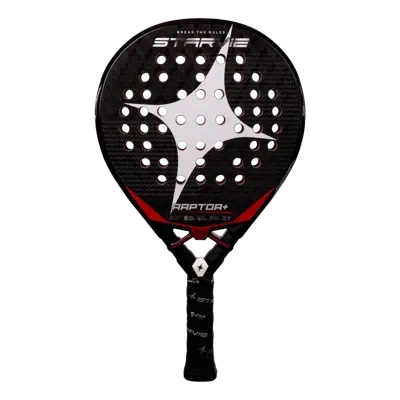
The cleanest comparison is the StarVie Raptor+ 2027. It shares the M-EVA Balance core, the medium balance, the teardrop shape, the 38 mm thickness and the 350 to 370 g window. Its meters match too: high control and medium for the rest.
Two things differ. The Raptor+ has a 3D Carbon face, where this racket has 12K Carbon Hyper. And its level label is Professional, against Intermediate here. So on paper the recipe is nearly the same, and the label is what separates them. Whether the faces play differently is something no reviewer has said.
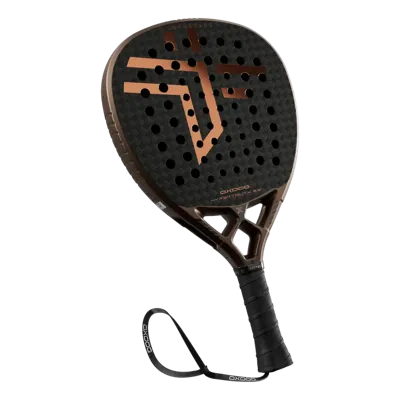
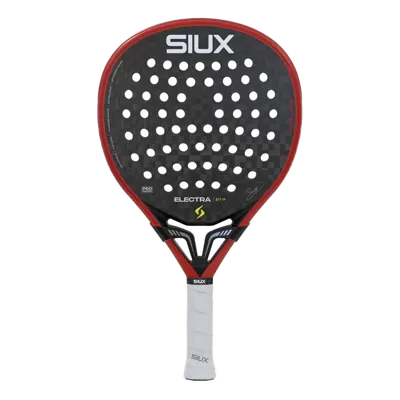
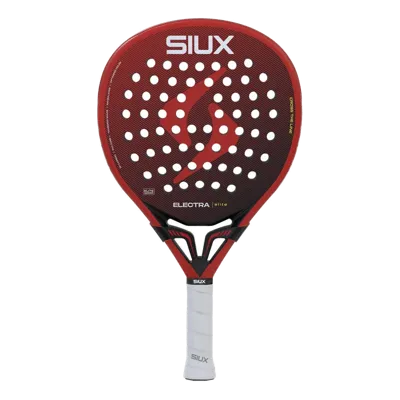
Another point of comparison is the Siux Electra Pro 2026. It is also a medium-balance teardrop, but it is listed at a higher level (Professional). Its comfort and maneuverability meters are Low. For this Drax + they are Medium. The Siux is listed at 355 to 375 g.
Rough surface, Shock Shield and Z-Shock: claims, not tests
The surface is listed as rough. StarVie's product page says this helps with spin and control. It also describes a curved hole pattern for stability and ball exit. It names a technical rubber called Shock Shield in the frame. It adds Z-Shock in the grip to absorb vibrations.
All of that is marketing copy. No reviewer has tested whether your arm notices any of it. The handle is listed as a longer handgrip, and the sheet says no more than that.
Not published: balance in mm, head size, frame and any court test
Some basics are missing. StarVie has not published the balance in mm, the head area or the frame. No pro player is attached to the racket either. The balance is only labelled Medium.
That means you cannot yet judge how head-heavy it is in numbers. If those figures matter to you, wait for them or for a first court test. Until then, the sheet gives a sensible, middle-of-the-road picture, and no more than that.