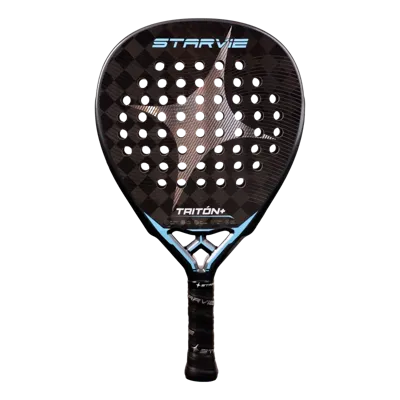
StarVie Tritón Power +
7.4padell.io scoreSpecs only- Shape
- Diamond
- Weight
- 358 g
- Balance
- Head-heavy
- Core
- H-EVA Power
The StarVie Tritón Power + is a diamond-shaped racket with a high balance label, listed at 358 g and 38 mm. StarVie markets it for attacking play. On paper it gives you high power and low control, comfort and maneuverability. No reviews exist yet, so this reads from specs alone. Choose it if you already hit hard and want a firm racket. Skip it if your arm needs forgiveness.
RBy Ruud Caris · facts checked 9 October 2026Choose it if
- you play an attacking game and want to finish points with smashes and fast volleys
- your timing is reliable enough that a small sweet spot does not bother you
- you are comfortable with a firm carbon face and a longer handle on a high-balance diamond
Skip it if
- control is your priority, since the StarVie Tritón T-One by Tamara Icardo reads Medium on control
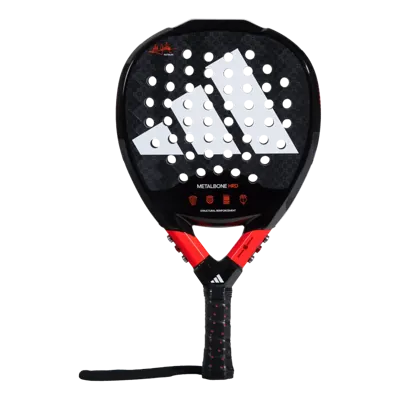
- you want a lighter racket, since the adidas Metalbone HRD+ 2026 is listed from 345 g
- your arm reacts to vibration or you are new to padel and need forgiveness on off-centre hits
How it plays
Line = the average of all rackets ▲ above ▼ below
On paper this racket pushes power up and gives away the rest.
- Control Low, because the diamond shape and high balance work against the stiff carbon face and the medium core.
- Power High, since the carbon face, the diamond shape and the high balance all point the same way.
- Comfort Low, as the stiff carbon face and the high balance outweigh what the core adds.
- Handling Low, because a diamond with a high balance is slower to swing around in quick exchanges.
- Forgiveness Low, which is typical for a diamond, so off-centre hits will cost you more than on a round racket.
Specifications
Not published by the brand: head size, frame
Specs from the brand's own site · checked 25 September 2026 · Spotted a wrong spec? Report it →
Video reviews
4 videos from independent channels and shopsPrice history
Lowest price per day across the shops in your market. Checked every night.
Put the StarVie Tritón Power + beside the Tritón Balance + and the specs will not help you choose. Both are listed at 358 g. Both are 38 mm diamonds with a high balance label. The meters match on all five lines. No reviews exist for either, so everything here comes from the listed specs.
Power + or Balance +: two names, one meter profile
The two rackets differ in only two listed details. The Power + has an H-EVA Power core and an 18K Carbon Hybrid face. The Tritón Balance + has an M-EVA Balance core and an 18K carbon face. Both read High on power and Low on control, comfort, maneuverability and sweet spot.
What do the labels tell you? Not much on their own. StarVie does not publish what separates H-EVA from M-EVA, or what "Hybrid" adds to 18K carbon. The Balance + is listed as Advanced. For the Power +, StarVie gives a play style, not a level. If you hesitate between the two, treat them as close cousins and wait for a reviewer who has played both.
Maximum power and control, says StarVie: the meters read Low control
The product page calls this a diamond with a high balance for attacking play. It claims the carbon face and the high-density H-EVA Power rubber give a firm feel for maximum power and control on decisive shots. It also says the rough surface helps spin and improves control.
Those are the brand's claims. The meters tell a different story on control: Low. The core and the stiff face raise it a little, but the diamond shape and the high balance pull it down further. Both can be true. A firm racket can feel precise when you hit the centre cleanly, and still be hard to control when you do not. Treat "control" here as a claim about clean hits, not about forgiveness.
H-EVA Power under 18K Carbon Hybrid: where High power and Low comfort come from
Power is the clear strength on paper. The carbon face, the diamond shape and the high balance each raise it. Nothing in the listed specs pulls it down.
Comfort goes the other way. The core is rated medium and helps a little. The stiff carbon face and the high balance lower comfort more. The product page claims a Z-Shock anti-vibration grip and a TriTech Core triple structure that improves balance and maneuverability. Treat both as marketing. Neither changes the Low comfort and Low maneuverability readings above, and no reviewer has confirmed them.
The face is listed as rough. That helps you grip the ball for spin, according to the brand, but it does not change the shape or the balance.
358 g, fixed, with a Longer Handgrip: what the heavy diamond asks of your arm
The minimum and maximum weight are both 358 g. That means no spread to choose from, so what you pick up is what you get. With a high balance, more of that mass sits toward the head. You may notice it when you swing late or defend at the net.
The listed handle is a Longer Handgrip. StarVie's page says it widens the hold for more firmness. On paper, this is a racket for a player with a sound technique and a healthy arm. Not a racket to grow into.
If you play a lot of long matches, the combination of a stiff face, high balance and a fixed weight is the part to think about. An overgrip and a lighter option elsewhere in the range are the practical answers.
Tritón Power + next to the T-One by Tamara Icardo and the Metalbone HRD+
The Tritón T-One by Tamara Icardo shares the 38 mm diamond shape and the 18K Carbon Hybrid face. It differs in three ways. Its balance label is Medium, its weight range runs from 347 g to 366 g, and its control meter reads Medium instead of Low. It is listed as Professional and tied to Tamara Icardo.
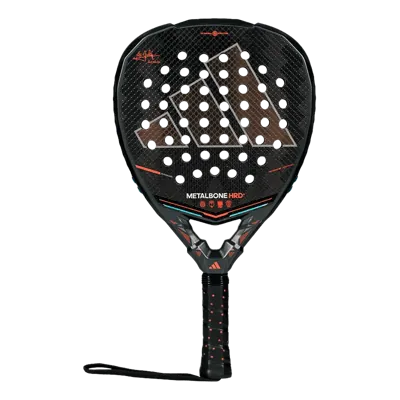
The adidas Metalbone HRD+ 2026 is also a 38 mm diamond with a head-heavy label. It has an EVA High Memory core and a 16K aluminized carbon face. It is listed from 345 g to 360 g, as Professional, with Ale Galán attached. Its five meters match the Power +. So on paper the choice between them is about weight range, materials and brand, not about a different kind of racket.
Frame, head size, balance in mm: what StarVie does not publish
Four things that matter on court are missing. StarVie does not publish the frame, the head size, the balance in millimetres or a weight system. "High" is only a label. Two rackets with that label can sit quite differently in the hand.
There is also a hidden listing called StarVie TRITON POWER in the line, with no specs and no year. Nothing published shows how it differs from this racket, so there is no version story to follow. Until reviews appear, ask a shop to let you hold the racket, and check how the head weight feels in your hand before you commit.
Similar rackets
Questions before you buy
Is the Tritón Power + the same as the Tritón Power?
Not clearly. A StarVie TRITON POWER listing exists in the line, but it is hidden and has no specs or year. Nothing shows what, if anything, changed, so a changed name is all you can say.
What is the difference between the Tritón Power + and the Tritón Balance +?
Only the core and face wording differ. The Power + lists H-EVA Power with 18K Carbon Hybrid, the Balance + lists M-EVA Balance with 18K carbon. Weight, thickness, shape, balance label and all five meters are the same.
Is the Tritón Power + a racket for beginners?
On paper, no. It is a diamond with a high balance, fixed at 358 g, and its meters read Low for control, comfort and sweet spot. StarVie describes it by play style, attacking, not by level.
Is it hard on the arm?
The specs point that way. The stiff carbon face and the high balance both lower the comfort meter to Low. StarVie claims its Z-Shock grip absorbs vibration, but no reviewer has tested that yet.
Is the Tritón Power + worth the money right now?
Today's price is labelled "Pricey today" compared with the rackets that play most alike. Which shops deliver, and what shipping costs, depends on your country. The price comparison shows it for yours.
See all pricesWhat is the closest alternative?
The adidas Metalbone HRD+ plays most alike. Differences: forgiveness -1.5, comfort -1.0. Today: € 205.95.
Compare side by side →Who should not buy it?
Skip it if you rely on placement and long rallies (control 4.0/10), or if your elbow or shoulder complains (comfort 4.0/10), or if you are still learning: it is not very forgiving (3.5/10).
How heavy is it really?
The brand gives 358 g. That counts as medium. Each racket can differ within that range.
Why a range? →