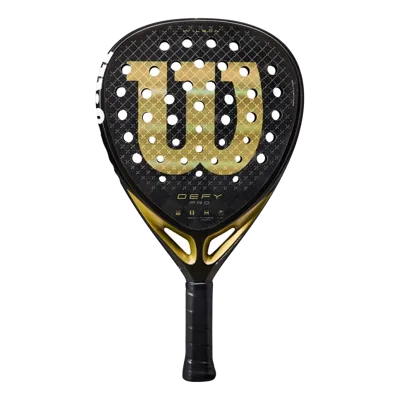
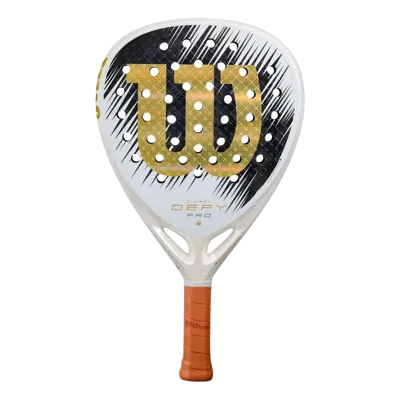
Nobody can tell the 2025 Defy Pro V1 from the 2026 SE by the sheet. Every spec that both list is the same, and the SE only adds numbers the older listing leaves blank. So this page is less about what changed and more about what this racket is, and who should hold it.
Same sheet, new suffix: what the SE adds and what it does not
The Wilson Defy Pro V1 SE lists a high balance, Power Foam core, 15K carbon face, diamond shape, Advanced level and 370 g. So does the 2025 racket. The SE also gives a balance of 265 mm and a thickness of 38 mm. The 2025 listing leaves both blank.
That is a gap in the listing, not a measured difference. Do not read it as a redesign.
One test, 71 out of 100: what padel.how found on a hard, fast diamond
Only one source has played this racket: padel.how, which rated it 71 out of 100. Its pros are strong acceleration and a pronounced spin texture that works at high speed. Its con is a narrow sweet spot that loses depth on lateral contact.
Its target player is an advanced attacker with a fast swing and clean upper-central contact. One test is a thin base, so treat it as a direction, not a final word.
Fast swing needed: why power reads High and the other four meters read Low
Power comes from several things pulling the same way: a stiff carbon face, a diamond head, a high balance and a heavy frame. The Power Foam core is soft, which pulls power down a little, but not enough to change the result.
The other four meters read Low. Diamond shape and high balance cut control and sweet spot size. Weight and stiffness cut comfort. Weight and balance cut maneuverability.
The racket does not do the work for you. You bring the speed. Not a racket that forgives a slow swing, but one that pays you back when you commit.
370 g with a high balance: what the heavy diamond asks of your arm
370 g is heavy. Add a high balance and the weight sits towards the head, which adds momentum to fast swings and hurts on quick defensive volleys.
What can you do about it? Be honest about your fitness and technique. If your arm tires over a long match, your contact point drifts, and this racket punishes that with its small sweet spot. A heavy diamond suits a player who is already hitting clean.
The product page claims the weight gives stability on aggressive shots. That is plausible, but it is a claim, not a test result. The same page says its hole pattern improves control and spin, and that its perforation technology enhances shots and optimizes accuracy. The retailer lists the surface as rough, and padel.how does praise the spin texture, so the spin part has some support.
Defy Pro V1 next to the Defy V1 and the Defy LS V1: one family, three builds
The Wilson Defy V1 2025 uses a 3K carbon face at 365 g and shares the Power Foam core. Its comfort meter reads Medium, against Low here. The Defy LS V1 2025 has a fibreglass face at 350 to 360 g, with Medium power and High comfort.
So the Pro V1 is the stiffest and heaviest of the three, with the 15K carbon face. If comfort matters to you, the siblings look closer. If you want the hardest hitter in the family, this is it.
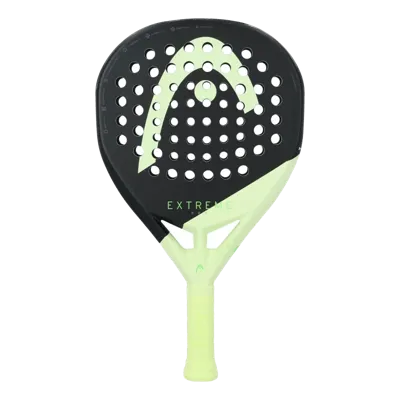
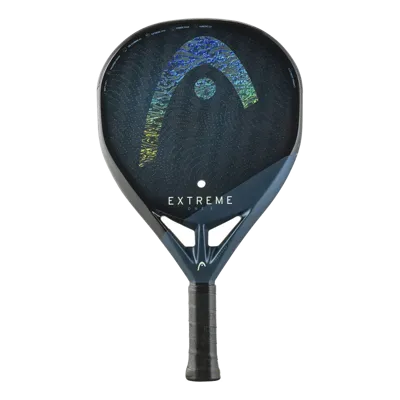
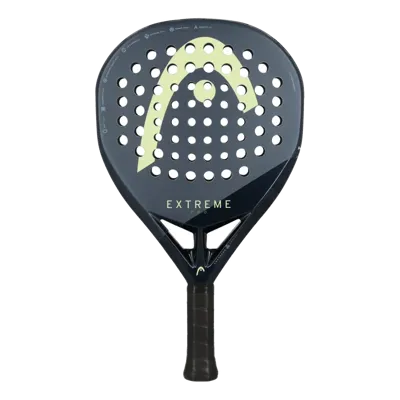
Outside the brand, the Head Extreme Pro 2026 is also a 370 g Power Foam diamond. Its control and comfort meters read Medium. That makes it the first racket to try if you like this shape but want a bit more margin.
Balance in mm, head size, handle: what the 2025 sheet does not publish
The 2025 listing gives no head size, no handle details, no weight system, no thickness and no balance in mm. It says only that the balance is high. You can still judge the character from shape, weight and face. Check the exact figures with the retailer before you buy, or look at the SE listing, which gives 265 mm and 38 mm.