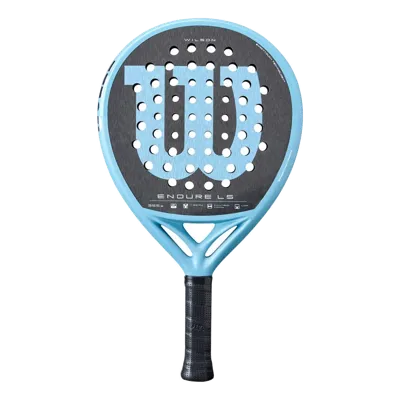
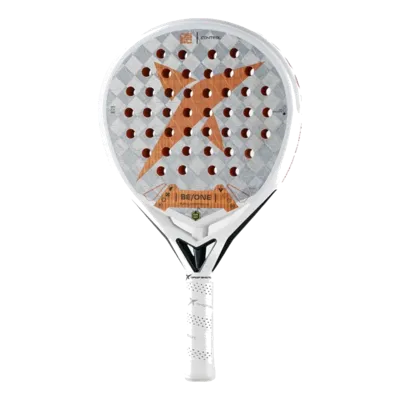
Wilson makes three Endure rackets for 2026, and they share one idea: a round head, a low balance and a control profile. The Endure LS V1 is the lightest of them. Shops list it at 355 g, with a 255 mm balance point, a carbon face, a Comfort Foam core and a rough surface. The other two weigh 365 g. That gap is the reason to look at this one.
Ten grams lighter than the rest of the Endure line
The Wilson Endure V1 and the Endure Pro V1 Momo González both come in at 365 g. The LS drops to 355 g. Ten grams sounds small on paper. Over a long match it adds up, because every volley, block and reset asks you to move the racket again.
The balance adds to that. At 255 mm the weight sits close to your hand. A low balance makes a racket swing lighter than the scale says, since less mass sits out at the head. The Pro V1 lists 260 mm, so the LS is both lighter and lower. The profile on this page rates its maneuverability high, while the Pro V1 gets low and the Endure V1 medium.
Which one is for you? If you want the racket to follow your hand quickly, the LS. If you want more mass behind the ball on blocks and volleys, one of the heavier two.
A control shape with a control balance
Round shape, low balance. That is the classic control pairing in padel. The round head keeps the sweet spot in the middle of the face and spreads it wide. The low balance keeps the head from pulling through the swing, so you place the ball more than you drive it.
The price is power. The profile rates it low, and every spec that decides power points down except the carbon face. Expect a racket that sends the ball where you aim but asks your arm for the pace. Smashes to the fence need good timing and a full swing. Not a finisher, but a placer.
Shops file it under every level from beginner to advanced, and the product page aims it at intermediate to advanced players. The specs fit that wide range. A beginner gets forgiveness from the round head, a more advanced player gets precision from the low balance.
Comfort Foam, or a dual-density core?
The listings do not agree on the core. The retailer's spec sheet calls it Comfort Foam. The product page describes a Control Foam core with two densities. A retailer also lists the core density as medium, not soft.
That matters for how it feels. A soft foam core absorbs more of the impact and keeps the ball on the face a fraction longer. A medium core gives a slightly firmer, more direct response. The profile here treats the core as soft, which is part of why comfort comes out high. If your elbow is sensitive, keep in mind that this reading rests on a label the sources describe differently.
The rest of the build is less in doubt. The face is carbon, which gives more precision and a firmer response than fiberglass. The neck is what Wilson calls a Y-Beam Throat, which the product page says adds stability. The surface is rough, which helps you put slice and spin on the ball.
A longer handle for two hands
One detail on the spec sheet is easy to miss: an extended handle. The product page says the longer grip helps two-handed backhands and gives extra leverage. That is a brand claim, but the logic is simple. A longer handle leaves room for a second hand. If you hit two-handed from the back of the court, check the grip length in your hand before you buy. If you never do, it changes little.
No court tests yet
Nobody has published a court test of this racket so far, and there are no videos or player threads either. Everything above reads the published specs and the product page. The weight is published as a single 355 g, not a range, and the balance point comes from one retailer. One retailer lists Momo González as the player for this racket. He is also listed for the Endure V1, and his name is in the title of the Endure Pro V1.
Torn between two light control rackets? The comparison with the Dunlop Galactica OS Lite puts two round, low-balanced frames side by side.