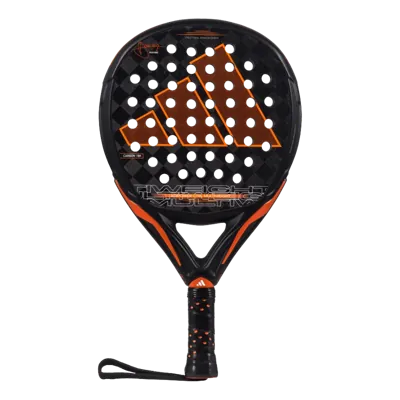
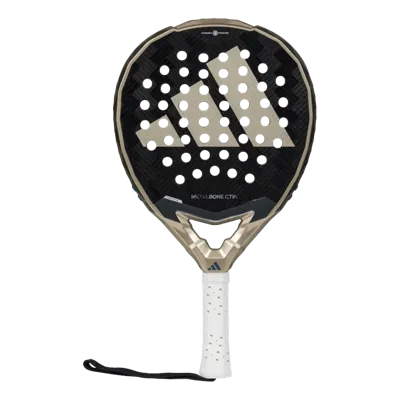
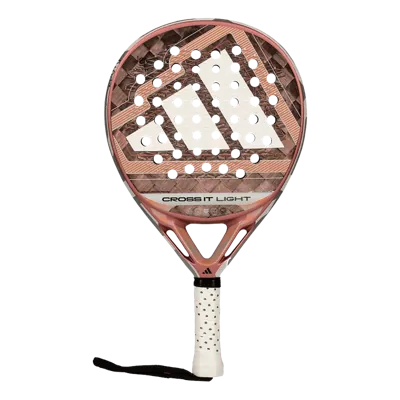
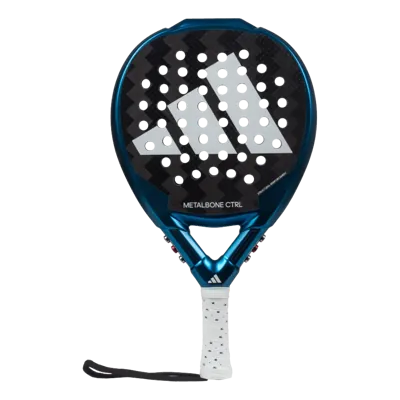
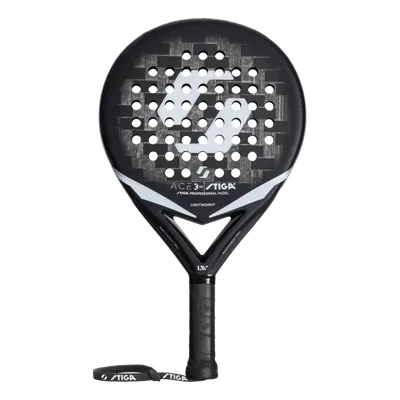
Same name, opposite temperament. The Adipower Multiweight 3.3 is a head-heavy diamond built to hit hard. This Ctrl 3.3 is its round, even-balance counterpart, built to keep the ball in play. There are no written reviews with ratings yet, so most of what follows comes from the specs and two video reviews.
Multiweight Ctrl against Multiweight: same core, opposite shape
Both rackets list an EVA High Memory core and an 18K carbon face. After that they split. The Adipower Multiweight 3.3 is a diamond with a Head Heavy label, and its meters read Low control and High power. This Ctrl 3.3 is round with an Even label, and its meters read High control and Low power.
So do not pick by the shared name. Pick by the shape and what you want from it. If you want pace from the back of the court, the diamond is the one to look at. If you want to place the ball and stay in the point, stay here.
Round head, 255 mm: where High control and High maneuverability come from
The head is 460 cm2 and the frame is 38 mm thick. The balance point sits at 255 mm, and adidas labels it Even. A round head puts the sweet spot closer to the centre. A lower balance keeps the weight nearer your hand.
On court, that should mean quick reactions at the net and easy defence. A retailer lists the racket at 455 mm long. This is not a racket that does the work for you. Rather, it is one that lets you place the ball. The sweet spot meter reads Medium, so you still need to find the middle of the head. One video reviewer called the sweet spot relatively small and said you need advanced technique to use the racket well.
Carbon face, firm core: why comfort reads Low
The face is Carbon Aluminized 18K, and carbon like this is stiff. The core is EVA High Memory, which the meters count in favour of comfort, and so is the low balance. They do not offset the face. The result on paper is a firm response.
A video reviewer said the racket can vibrate slightly on hard blocks. That fits the Low comfort reading. If your arm is already sensitive, the adidas Adipower Light 3.3 reads High for comfort and is a fair point of comparison. The handle spec is not published, and the same reviewer found the stock handle too small and slippery.
What removable weights can change, and what adidas leaves open
The product page claims the removable weights let you shift the racket toward more control or more power, and that they change balance and total weight. That is a brand claim. adidas does not publish how many grams the weights add or how far the balance moves.
What is published: the weight range runs from 345 g to 360 g, and the system is called Weight & Balance System. A round shape and a low balance are the main source of the control on the meters. The weights are more sensibly read as a way to tune the racket a little, not as proof it can be turned into a power racket. A video reviewer liked the adjustable system and called the build very solid.
Ctrl 3.3 or Ctrl 3.4: reading the next step in the line
The Ctrl 3.4 is listed at 265 mm balance and 360 to 375 g, with Intermediate level. Its release year is not given and its data is incomplete. It is heavier and more head-weighted on paper, so it is not a simple swap. Check the numbers again once its data is complete.
Ctrl 3.3, Metalbone Ctrl 3.3 or Adipower Light 3.2: picking your round control racket
The Metalbone Ctrl 3.3 has the same weight range and shape, but reads Medium comfort and High sweet spot, with Medium maneuverability. See the direct comparison. The Adipower Light 3.2 shows the same pattern. Choose this Ctrl 3.3 if quick handling matters more than a roomy sweet spot, and if your arm copes with a firm face.