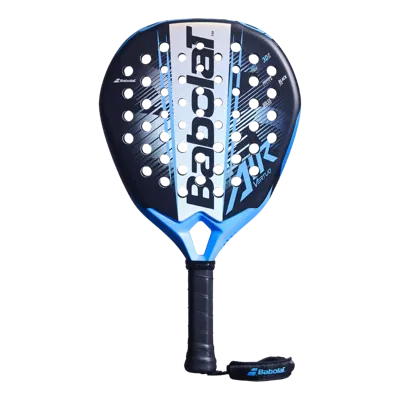
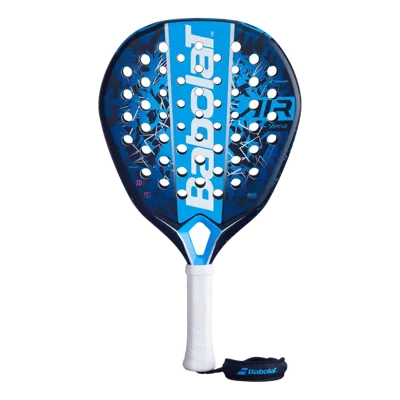
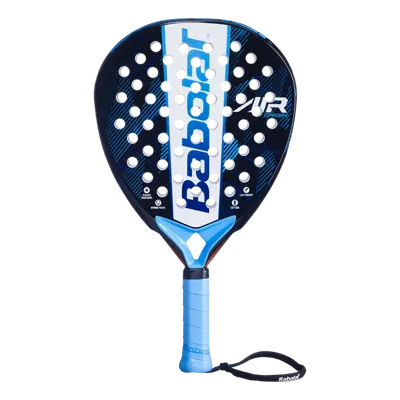
The Babolat Air Vertuo 2.6 keeps the fiberglass face, the teardrop head and the 38 mm profile of last year's Air Vertuo. Almost everything underneath has been reworked. The core, the surface texture, the weight and the balance label all differ. A retailer lists it as an attacking racket. The reviews tell a more modest story.
Black EVA in, X-EVA out: what the 2.6 changes against the 2025 Air Vertuo
The 2025 Air Vertuo used an X-EVA core and a rough surface. The 2.6 lists Black EVA and a 3D Spin surface. Face, frame, shape and thickness are the same.
What does that mean for you? Not a new racket, but a changed one. The core is the part that decides how firm the response is. The meters read Black EVA as a harder core, yet a video review calls the core soft. Sources disagree here, so do not assume either. Hit with it before you commit if you can.
The handle is listed as Syntec Team. For the 2025 model the handle is unknown, so there is nothing to compare.
335 to 355 g instead of a fixed 345 g: a weight range that moves
The 2025 model was listed at 345 g, no range. The 2.6 is listed at 335 to 355 g. The brand's own nominal figure is 345 g, so the middle of the range matches last year.
The range matters in practice. Two copies of the same racket can differ in your hand. A 335 g one is very light. A 355 g one has more mass behind the ball. Check the weight of the one you buy if your arm is sensitive.
The balance label also changed, from Medium to Even Balance. A retailer lists the balance point at 265 mm. Treat that as a shop figure, not a brand figure. It is a middle value, neither head-heavy nor head-light, which fits a racket meant for quick hands.
68 out of 100 from padel.how: quick and forgiving, short on control
The padel.how review rated the racket 68 out of 100 after testing it. It praises quick handling, easy ball exit and a soft, forgiving response with low fatigue. Its main complaint is limited control and precision against fast balls. It marks power and control as negative, comfort as positive and the sweet spot as neutral.
A video review from Padel Reviews gives a similar picture. It likes the light, agile frame and the arm-friendly damping. It lists a soft core that caps maximum power. It also finds a sweet spot higher on the face and a surface that lacks the roughness for advanced spin.
The practical reading: this racket helps you create speed when you have time. It helps less when you are under pressure and need to place the ball.
The product page promises balance: the meters say otherwise
The product page, which is marketing, describes a balance of handling, comfort and power, with full control in attack and defence. Parts of that hold up. Handling and comfort match what reviewers found.
Control and power are weaker. The meters read both as Low, pulled down by the fiberglass face and by reviews that call both negative. A teardrop shape and a medium balance push control up a little, but not enough to offset the rest. Read the claim as aimed at attacking players who want easy pace. It is not aimed at those who want to dictate points with accuracy.
Air Vertuo, Air Veron and Air Viper 2.6: same year, three different faces
All three share a teardrop shape, 38 mm thickness and a 265 mm balance. The face is what separates them.
The Air Veron 2.6 has a Carbon Flex face and a fixed 355 g. Its meters read Medium for control, power and sweet spot, but Low for comfort. The Air Viper 2.6 uses a 16K carbon face and reads High for control and power, again with Low comfort.
The Vertuo is the soft end of the family. You trade control and power for comfort. If your arm is healthy and you want more precision, the carbon siblings are the better fit.
Air Vertuo 2.6, Siux Beat Hybrid 3 Air or Kuikma PR React: picking your light teardrop
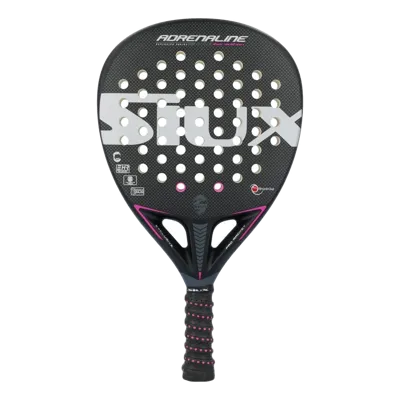
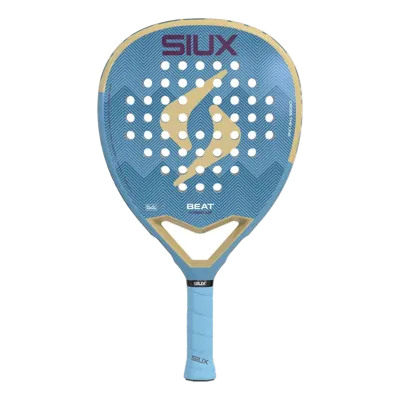
The Siux Beat Hybrid 3 Air is also a fiberglass teardrop at 38 mm, listed at 340 to 360 g. It reads Medium for control and sweet spot and High for comfort, so it is the calmer pick. Power reads Low, like the Vertuo.
The Kuikma PR React uses a flax and fiberglass face and is listed at 341 to 360 g. Its meters are close to the Siux.
The Vertuo's case rests on being the lightest of the three at the low end of its range, and on the attacking tag. The case against it rests on the control and sweet spot readings.