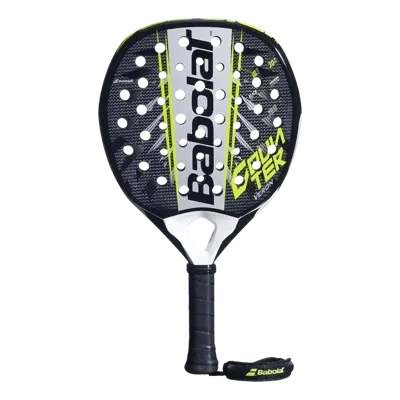
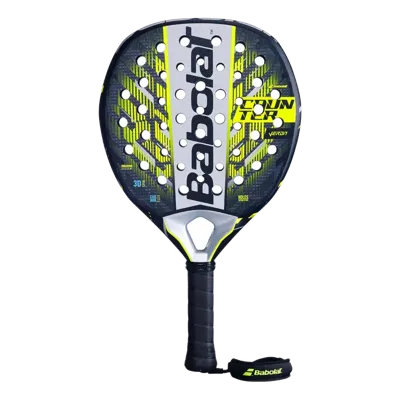
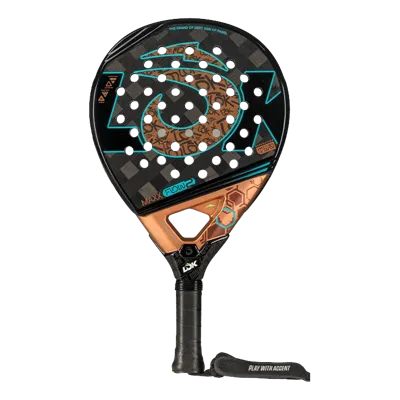
Between the Babolat Counter Veron 2025 and the Counter Veron 2.6, four published specs moved. The biggest one is the shape: the hybrid is gone, replaced by a full round head. That one change says a lot about what this racket wants to do. It defends first, counters second, and asks you to supply the finishing power yourself. One retailer does list the player profile as attacking, which shows how loosely these labels get used. The specs and the court test point the other way: this is a control racket.
Hybrid out, round in: the rebuild since the Counter Veron 2025
The Counter Veron 2025 was a hybrid shape. The 2.6 is round. On court that shifts the balance of the racket towards control and away from free power. A round head spreads the hitting zone more evenly and keeps the sweet spot accessible on low, stretched balls. That is exactly where a counter player lives.
Weight, face, frame and thickness all stayed the same: 365 g, Carbon Flex face, carbon frame, 38 mm profile. So the character changed, but the platform did not. If you played the 2025 model and want a direct comparison, see Counter Veron 2.6 versus Counter Veron 2025.
Black EVA instead of X-EVA: what the new core does to the feel
The 2025 version ran an X-EVA core. The 2.6 switches to Black EVA. The response is firm and direct. You feel where the ball hits. Mishits tell you about it.
The trade-off is comfort. A firm core sends more vibration into the arm than a soft one. Babolat says its VIBRABSORB SYSTEM² Technology counters that. The Carbon Flex face, a blend of carbon and more flexible fibres, also softens contact compared to a full carbon face. Babolat's own claim is that this mix pairs carbon's precision with easier playability. Treat that as the brand talking, not a measurement. The tested review does call the racket more comfortable than the Counter Viper, which supports the direction of the claim.
If you have a history of elbow or shoulder trouble, be honest with yourself here. Firm foam at 365 g is a demanding combination over long sessions.
365 g fixed, 270 mm, Carbon Flex face: where the control comes from
There is no weight range. The 2.6 comes at 365 g, full stop. That is heavy for a round racket. Heavy is a deliberate choice here. Mass behind the ball gives stability on blocks and lobs, the shots a counter player plays most.
The balance label says head-heavy. One retailer lists the balance point at 270 mm, which is medium rather than extreme. Those two statements sit in tension. The safest reading is this: the racket carries its weight towards the head compared to an even-balance frame, but it is not a sledgehammer. Expect a steady swing, not a whippy one.
The Carbon Flex face does the rest. Carbon gives the response precision. The flexible fibres keep the ball on the face a fraction longer. On paper that combination favours placement: lobs that land deep, chiquitas that die at the net.
73 out of 100 from the one court test: forgiveness praised, agility flagged
One source has played this racket on court: padel.how, which rates it 73 out of 100. The praise goes to the large round sweet spot and the forgiveness. The reviewer also found it easier to get depth and comfort out of it than out of the Counter Viper. The criticism targets agility: the head-heavy platform limits you in fast exchanges.
That is a coherent picture. The racket rewards a patient game from the back and punishes nothing except late, rushed hands at the net. If your game is built on quick volleys and reflex blocks, this is the friction you will feel.
Rough out, 3D Spin in: the surface change and what it is worth
The 2025 model had a rough surface. The 2.6 gets Babolat's 3D Spin finish, a textured pattern on the face. Textured surfaces aim to grip the ball a little longer on sliced and topspin shots.
Keep the expectation modest. Surface texture adds a bit of bite. It does not turn a control racket into a spin machine, and no tested source has measured the difference between the two finishes. Consider it a small bonus on your bandeja and vibora, not a reason to buy.
Veron, Viper or Vertuo: picking your 2026 Counter
Within the 2026 Counter family, the Veron sits in the middle. The Counter Viper 2.6 shares the weight and the balance. It runs an X-EVA core and a full 3K carbon face, and Babolat aims it at advanced players. It is the stricter racket. The Counter Vertuo 2.6 goes the other way. It is lighter at 340 to 360 g, with an even balance and a fiberglass face. That makes it the easy-swinging option.
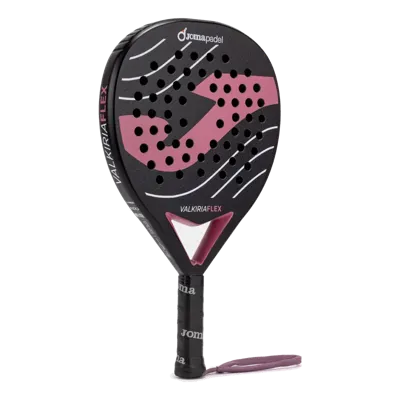
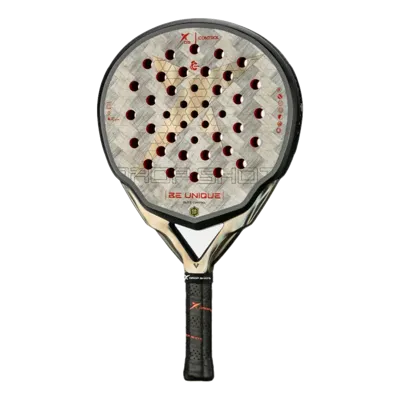
So the choice inside the family is simple. Want the firmest, most demanding frame? Viper. Want the lightest and most forgiving? Vertuo. Want carbon feel with some give, at full weight? That is the Veron 2.6. Outside Babolat, the Joma Valkiria Flex and the Drop Shot Blitz Control cover nearby ground if you want more power from a round head.