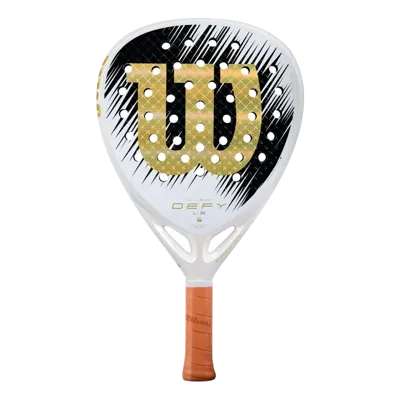
Wilson Defy LS V1 SE
7.5padell.io scoreSpecs only- Shape
- Diamond
- Weight
- 355 g
- Balance
- Head-heavy
- Core
- Foam
The Wilson Defy LS V1 SE is a soft foam-core diamond rated Advanced, fixed at 355 g with a 265 mm balance. On paper it is a comfort-first attacking racket: comfort reads High, power Medium, control Low. No review exists yet, so this is a spec-sheet read. The catch is the demanding diamond shape.
RBy Ruud Caris · facts checked 9 October 2026Choose it if
- you want a diamond-shaped attacking racket but your elbow or shoulder dislikes stiff, hard-hitting frames
- you are coming from last year's Defy LS V1 and want to see what the carbon in the face does
- you accept that a diamond asks for clean contact and want a soft, comfortable face in return
Skip it if
- you want a forgiving, easy racket for rallies, since the Tecnifibre Bomba Speed reads just as demanding and a rounder shape would suit you better
- you need the most power from a diamond, since the Head Extreme Edge 2025 reads High on power against Medium here
- you want a head size or frame spec before buying, because retail listings do not publish them for this racket
How it plays
Line = the average of all rackets ▲ above ▼ below
On paper this is a soft, comfort-led diamond that rewards good timing more than it forgives mistakes.
- Control Low, because the diamond shape pulls it down even though the foam core and the balance point help.
- Power Medium, as the soft foam holds the diamond's natural power in check.
- Comfort High, thanks to the foam core and the ComfortFlex face, which is the strongest point of the profile.
- Handling Low, because the diamond shape makes it slower to swing around, even though the balance point works in its favour.
- Forgiveness Low, because a diamond head is small in the area that counts, even with a soft core.
Specifications
Not published by the brand: head size, handle, frame
Specs from padelnuestro.com · checked 23 September 2026 · Spotted a wrong spec? Report it →
Video reviews
1 video from an independent channel or shopEvery version
Compare all versions →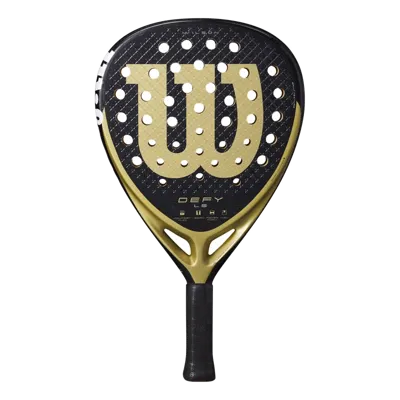
Two listed specs differ from the 2025 Defy LS V1. The face goes from fiberglass (Fiberflex) to carbon and fiberglass (ComfortFlex). The weight goes from a range of 350 g to 360 g to a fixed 355 g. Core, shape, balance label and level are listed the same. Balance in millimetres and thickness are not published for the 2025 version, so they cannot be compared. Look at the SE if you want carbon in a soft diamond, or at the 2025 model if you prefer the older listing. Whether the change is large on court is unknown, because no review covers either racket in detail here.
Price history
Lowest price per day across the shops in your market. Checked every night.
The Wilson Defy LS V1 SE keeps last year's foam core, diamond head and high balance. Two things moved: the face now has carbon in it, and the weight is fixed at 355 g. No review of this racket exists yet. Everything below comes from the specs, and the gaps are named as they come up.
Carbon joins the face: what the SE changes against the 2025 Defy LS
The 2025 Defy LS V1 is listed with a fiberglass face, called Fiberflex. The SE is listed with carbon and fiberglass, called ComfortFlex. That is the main change.
What does it mean for you? Carbon is often stiffer than fiberglass, so the face of the SE may respond a little more crisply. That is a guess from the materials, not a measured result. The core is foam in both years. The shape is diamond in both. The balance label is high in both, and the level is Advanced in both. This is the same racket family with a different skin, not a new design.
One limit: the 2025 listing does not publish balance in millimetres or thickness, so those two cannot be compared.
355 g instead of 350 to 360 g: what a fixed weight means
The 2025 version was listed from 350 g to 360 g. The SE is listed at 355 g, with no range. The midpoint is the same, so the average racket barely changes. What changes is the spread.
With a range, two rackets from the same box can differ in weight. A single figure suggests less variation between samples. Whether production really is tighter, the listings cannot tell you. For a high-balance diamond, 355 g is not light. Weigh it against your own arm before you commit.
Foam core, ComfortFlex face: why comfort reads High and control Low
The comfort meter reads High. Two things drive it: the soft foam core and the mixed carbon and fiberglass face. Both point to a racket that absorbs shock, which matters if your arm complains after long sessions.
Control reads Low, and sweet spot reads Low. The reason is the diamond shape. It puts the weight high in the frame and shrinks the forgiving area of the head. The soft core and the 265 mm balance push control up, but the shape wins. Thickness is 38 mm, which says little by itself.
So the picture is odd but consistent: a racket that is kind to your arm and unkind to your timing. You pay for comfort with precision.
Power, comfort and control, says the product page: the meters answer differently
The product page claims accessible power, comfort and control. It calls the racket a crossover between power and stability. That is marketing language, and the meters only half agree.
Comfort fits. Power sits at Medium, which is usable but not high. Control reads Low, so the promise of control is the weakest part. The product page also talks about a manageable offensive game for intermediate and advanced players. A retailer listing tags it Advanced and as an offensive racket. If you are an intermediate player, the Low control and Low sweet spot readings are worth weighing before you believe the pitch.
Defy LS V1 SE next to the Defy V1 SE and the Defy Pro V1 SE
Two siblings from the same year show where this racket sits.
The Defy V1 SE has a 3K carbon face, high-density Power Foam and a weight of 365 g. Its meters read High power, Low comfort and Low control. It is the harder-hitting choice.
The Defy Pro V1 SE has a 15K carbon face, Power Foam and a weight of 370 g. It reads High power, Medium control and Low comfort. It is the heaviest of the three.
The LS is the odd one out. It is the lightest at 355 g, has the softest setup and is the only one with High comfort. It gives up power to get there. If your arm is fine and you want output, look at the siblings. If your arm needs a kinder racket, the LS is the one in this group that reads that way.
No review, no head size, no frame: what you cannot check
No tester has published a court review of this racket yet. Head size, frame construction, handle and weight system are not published either. That means you cannot judge the exact face area or how stiff the frame is.
The meters are calculated from the specs. They describe tendencies, not how the racket plays in your hands. If you can try one at a club or demo day first, do that. Pay attention to how it handles off-centre hits, since that is where a diamond with a Low sweet spot reading will show its limits.
Similar rackets
Questions before you buy
Is the Wilson Defy LS V1 SE good for beginners?
Not on paper. It is a diamond with a Low control reading and a Low sweet spot reading, and the retailer listing tags it Advanced. A rounder racket would be easier to learn on.
What is different from the 2025 Defy LS V1?
The face is now carbon and fiberglass (ComfortFlex) instead of fiberglass, and the weight is fixed at 355 g instead of 350 g to 360 g. Core, shape and balance label are listed the same.
Is it easy on the arm?
The specs point that way. The foam core and the mixed face push the comfort meter to High. No tester has confirmed it yet, so this is a spec-based expectation.
How does it compare with the Head Extreme Edge 2025?
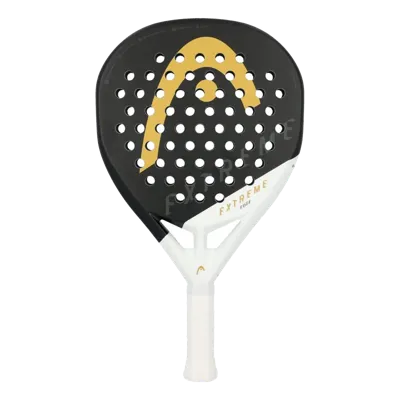
Both are high-balance diamonds. The Head reads High on power and Medium on comfort, while the Wilson reads Medium on power and High on comfort. Pick by what matters more to your arm and your attacking game.
Is the Defy LS V1 SE worth the money right now?
Today's price is labelled "Fair price" compared with the rackets that play most alike. Which shops deliver, and what shipping costs, depends on your country. The price comparison shows it for yours.
See all pricesWhat is the closest alternative?
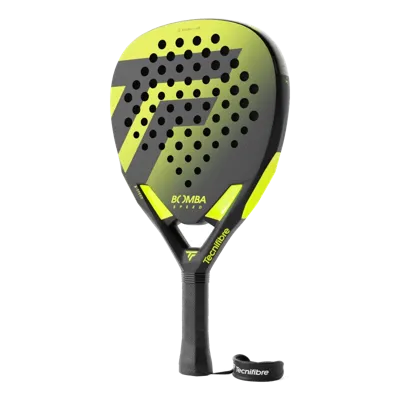
The Tecnifibre Bomba Speed plays most alike. On paper the differences are under one point. Today: € 166.55.
Compare side by side →Who should not buy it?
Skip it if you rely on placement and long rallies (control 5.0/10), or if you are still learning: it is not very forgiving (4.0/10).
How heavy is it really?
The brand gives 355 g. That counts as medium. Each racket can differ within that range.
Why a range? →