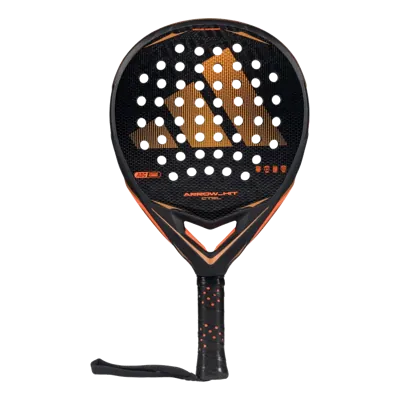
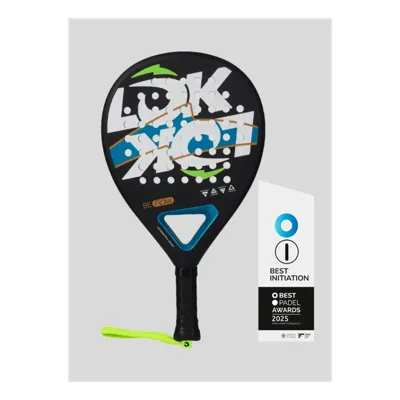
The adidas Arrow Hit Ctrl 2026 is the only round racket in a 2026 Arrow Hit family built on diamonds. adidas labels it Professional level. A retailer links it to Alex Ruiz. Everything about the build says control first.
The round one in a family of diamonds
The plain Arrow Hit 2026, the Arrow Hit Carbon and the Ari Sánchez version all come as diamonds. All head-heavy. The Ctrl goes the other way: round shape, even balance. That is not a small tweak. A round head with an even balance keeps the mass closer to your hand. The racket rewards placement over finishing. If you want the family's power side, the Ctrl is the wrong door.
EVA Soft Performance under ASC carbon: a soft, steady recipe
The core is EVA Soft Performance, the same soft foam adidas uses across the 2026 Arrow Hit line. The face is ASC carbon. The frame adds what adidas calls Structural Reinforcement and a Muscle Power System. The handle gets an Extra Power Grip. The surface carries a Spin Blade Decal texture.
The brand describes carbon tendons through the heart of the racket to increase torsional resistance. Treat that as a claim, not a measurement. What matters on court is the combination: soft foam under a medium carbon face. That gives a compliant, damped contact. Good for absorbing pace. Less good for generating it.
A sliding weight you move with an Allen key
The Intelligent Balance System is a weight on a rail in the frame. You loosen it with an Allen key, slide it, and tighten it again. adidas's own instructions say: towards the head for more power, towards the handle for more control. The racket weighs 360 to 375 g depending on setup. It sits in a heavy class either way.
This is the most practical feature on the racket. It lets one frame cover two temperaments. But note what the court tests found. Power is the weak point, whatever you do with the slider. Moving the weight towards the head helps. It does not turn this into a power racket.
67 out of 100 here, 9.6 out of 10 there: reading the split
Two sources actually played this racket, and they land far apart. padel.how tested it and gave it 67 out of 100. Positive on control, comfort and sweet spot. Negative on power. Their reviewer wrote: "I would use the Arrow Hit CTRL for patient point construction: controlled returns, repeatable lobs and directed volleys."
A video review from Justpadel, also an on-court test, went the other way. It scored the racket 9.6 out of 10 and called it one of their current favourites. The praise: a large sweet spot, a soft touch without a trampoline effect, and high precision. Their one criticism matches padel.how. The racket needs weight adjustment for maximum power. The disagreement is not about what the racket is. It is about how much a low power ceiling should cost it. Decide which reviewer plays like you.
The balance in millimetres adidas has not published
One honest gap. adidas labels the balance Even but has not published the balance in millimetres. The head size is also not published. The sibling Arrow Hit Carbon Ctrl 2026 is listed at 260 mm. That hints at the neighbourhood, but it is a different racket. No guessing here. If the exact balance point decides your purchase, you will have to measure it in a shop.
Arrow Hit Ctrl, Carbon Ctrl or Adipower Ctrl: picking your control adidas
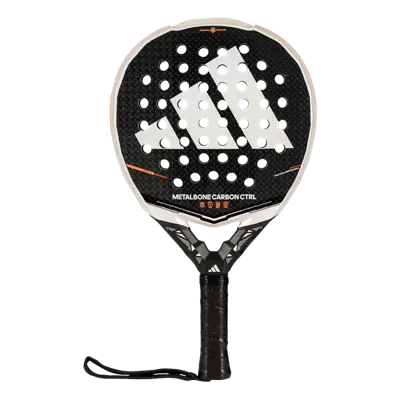
Within the family, the Carbon Ctrl is the closest relative. Same round shape, same even balance, same weight range, same core. Plus a published 260 mm balance. If you want the numbers on paper before you buy, that sibling is the safer documented choice.
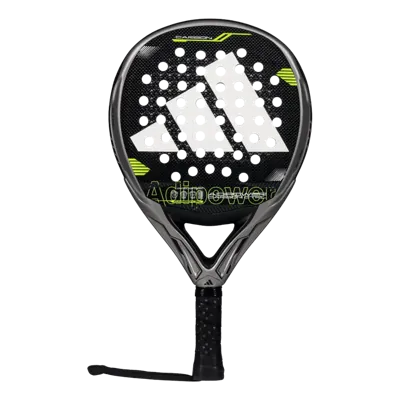
Outside the family, the adidas Adipower Ctrl 3.3 matches this racket almost spec for spec. Round, even, 38 mm, 360 to 375 g, same soft core. Its comfort rating runs High against Medium here. If arm-friendliness matters, that comparison is worth opening. The Kuikma Control Pro is another round, even-balance control racket in the same weight class if you want to widen the search.