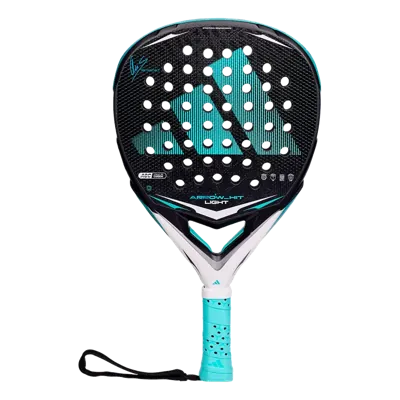
This is a head-heavy diamond, and its power meter reads High. Then you watch the three court tests, and all three call it light, precise and easy to move. That tension runs through everything about this racket. The numbers point one way, the reviewers point another, and both are worth understanding before you decide.
High power on the meter, three court tests say precision
The profile meters here are computed from the specs. Diamond shape, head-heavy balance, carbon face: that recipe gives High power, Low control and Low maneuverability. No written reviews of this racket exist yet, so the meters are the only spec-based reading.
The three video reviews, all from channels that played it on court, tell a different story. Fabio Ferro calls it technical and direct. Padel Review calls it highly precise. PADELREVIEW ENG describes a tactical racket for skilled players rather than a cannon. That is not a minor disagreement. If you buy rackets from spec sheets alone, this one will surprise you on court.
345 to 360 g, diamond, head-heavy: what the fixed numbers say
Some specs are not in dispute. The weight runs from 345 g to 360 g, which is light for a diamond racket. The thickness is 38 mm, the standard attacking profile. The shape is diamond, the balance label head-heavy, and the frame is carbon. The length is 455 mm.
That combination explains the contradiction. A light total weight makes the racket easy to swing and quick in the hand. That is exactly what the reviewers noticed. But the mass still sits towards the head, so the meter registers Low maneuverability and High power. Both can be true at once: fast to move, heavy where it counts when you accelerate.
EVA Soft Performance under ASC carbon: the soft core both sides agree on
The core is EVA Soft Performance, a soft foam. On the meter, a soft core raises comfort and control and pulls power down. The face is ASC, a carbon-medium fiber, and the surface carries adidas's 3D Spin Blade texture.
Fabio Ferro describes the result as a stiff carbon face over a soft EVA core, giving a crisp and direct feel. That matches the construction. A soft core with a firm face tends to hold the ball a fraction longer on slow shots. That helps placement, then it responds firmly when you swing hard. The soft core is also why the meter rates comfort Medium rather than Low, despite the head-heavy balance working the wrist.
Where the three court tests agree and where they split
All three reviewers agree on the broad character. It is light, maneuverable and precise, and it suits advanced players with developed technique. All three note that the sweet spot is not large. Two of them flag weak ball output on slow shots and overheads. Fabio Ferro says it lacks ball output when you swing slowly. Padel Review says it lacks power for overhead shots.
They split on comfort. Padel Review found it comfortable and tactile. Fabio Ferro found it not very comfortable and said it demands a good rhythm. That disagreement matters if your arm is sensitive. Two of the three also mention the handle. Padel Review calls it a bit small, PADELREVIEW ENG calls it relatively short. Yet the product page markets the Extra Power Grip as a longer handle that shifts mass towards the head.
Low control, Low sweet spot, unpublished balance: what you cannot check
Take the meters at face value and this racket asks a lot. Low control and a Low sweet spot mean the ball goes where the racket head points when your timing slips. A 345 g diamond with weight in the head is easier to mistime than a round racket at the same weight. The practical answer is rhythm. Fabio Ferro is explicit that the racket performs when you keep a good rhythm and falls away when you do not.
One gap is worth naming. adidas labels the balance head-heavy but does not publish it in millimetres. The head surface in square centimetres is also not published, and no adjustable weight system is listed. The product page does claim "customizable balance", but no weight system appears in the specs, so treat that claim with caution. Two rackets can both be labelled head-heavy and still feel different at different millimetre points. Here you cannot verify where this one sits. The court tests are your only substitute, and they suggest it plays lighter than the label.
Arrow Hit Light, Arrow Hit Carbon Ctrl or Head Coello Motion 2026
The Arrow Hit family is wide in 2026. The standard adidas Arrow Hit shares the diamond shape, head-heavy balance, core and face. It runs heavier at 360 to 375 g and rates Low on comfort. The Light version keeps the recipe and drops the weight. If you want the same idea with more mass behind the ball, that is the one to compare.
If control is what you actually want, the adidas Arrow Hit Carbon Ctrl is the round sibling: even balance at 260 mm, High control and a High sweet spot on the meter, at 360 to 375 g. It flips the whole character while keeping the same core and face.
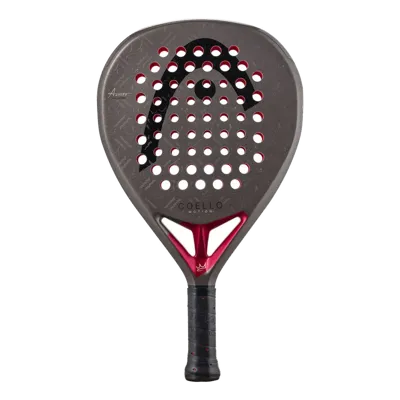
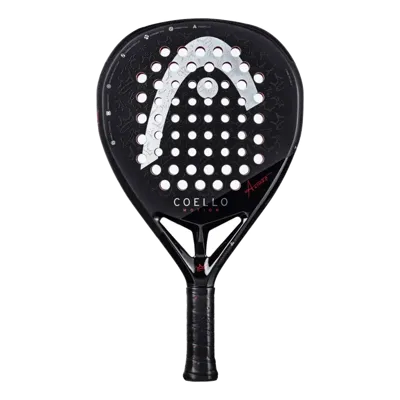
Outside adidas, the Head Coello Motion 2026 is the natural rival: diamond, high balance at 268 mm, 360 g, High power. Its control meter reads Medium against Low here, on paper the friendlier attacking option.