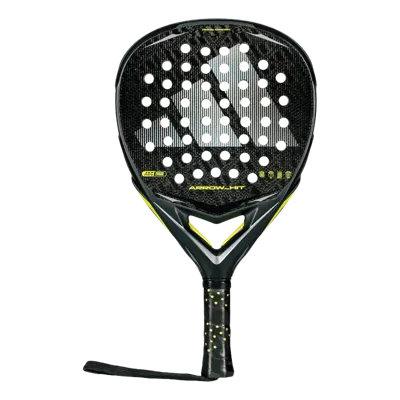
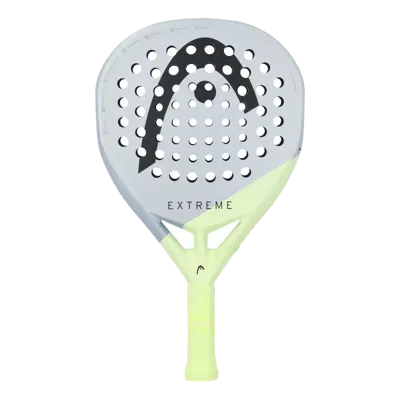
The adidas Arrow Hit 2026 is a head-heavy diamond with one unusual trait. adidas publishes no balance in millimetres, because a sliding weight on a rail lets you move it yourself. Ari Sánchez plays this exact model, on the left side. Everything else is a classic attacking build: 360 to 375 g, 38 mm thick, a soft EVA core under a carbon face. Whether the rail is a gimmick or a genuine tool is exactly where the reviewers split.
A rail instead of a number: the balance you set yourself
adidas calls it the Intelligent Balance System. A weight sits on a rail on each side of the blade. You loosen it with an Allen key, slide it toward the head for more power or toward the handle for more control, and tighten it again. That is the brand's own description, and it explains the missing spec: a racket with a movable balance has no single number to print.
The product page adds more claims. Carbon ribs cross the heart of the racket to resist torsion, adidas says. A longer handle increases inertia. A new adjustable rope string with a padded wristband should sit softer on the wrist. Treat all of this as marketing until someone measures it. What is measurable, adidas has published: the label Head Heavy is the starting point, wherever the weight ends up.
360 to 375 g, diamond, head-heavy: what stays fixed whatever you slide
The rail moves the feel, not the foundation. The frame still weighs 360 to 375 g. The profile is still 38 mm, the standard thickness for attacking rackets. The shape is still diamond, which puts the mass toward the top.
On court that means a slow swing path when you are late, and free mass when you are early. Quick defensive reactions at the back glass cost effort. Volleys ask for a short, compact movement. Overheads, the other way round, get help from physics: a heavy head falling through the ball does part of the work for you. The maneuverability meter reads Low, and no rail position changes the shape that causes it.
EVA Soft Performance under ASC carbon: soft core, firm face, Low comfort on the meter
The core is EVA Soft Performance, a soft foam. Soft cores give easy ball output and absorb part of the vibration, which is why so many comfort-oriented rackets use them. Here it works against the rest of the build: the comfort meter still reads Low, pulled down by the weight and the high balance.
The face is ASC, a carbon layup, finished with a Spin Blade Decal texture for grip on the ball. Soft inside, firm outside. That suggests easy ball launch without a full swing, plus bite on sliced bandejas and kick smashes. The one court test in the reviews confirms the overhead side of that picture. If your arm is sensitive, the honest answer is that no soft core fully cancels out 375 g hanging high. Test the lighter sibling first, or look at a round shape.
One rail, four opinions: where the reviews agree and split
padel.how played the racket and rated it 72 out of 100. The testers praised the adjustable balance for enabling multiple setups and liked the overhead finishing, helped by the spin-friendly surface. Their warning: a compact sweet spot that demands precise timing. Their summary: the rail is practical, but no reason to overlook forgiveness or defensive recovery.
The video reviews disagree with each other in an interesting way. Ariel Padel Reviews awarded ten out of ten. He called it comfortable and easy to adapt to. That video, however, was not an on-court test. Three channels that did play it split down the middle. Simone Mazzola found the balance system highly effective, while noting it needs careful setup and more physical effort in offensive mode. Padel Review and PADELREVIEW ENG report the opposite. They found the racket unstable in the hand without the weights. Padel Review also judged the system itself not very effective. Read together, the message is consistent enough: the rail rewards players who set it up deliberately, and punishes those who ignore it.
Compact sweet spot and Low control: what the diamond asks of your timing
The meters put control and sweet spot at Low. That is the diamond tax: a small, high hitting zone that pays out in power and collects in mishits. padel.how's court test lands on the same point, and even Ariel's enthusiastic video admits the ball comes off the face too fast on volleys.
You can work around some of it. Prepare earlier than feels necessary. Slide the weight toward the handle for sessions with a lot of defence. Keep volleys short and let the racket's own pace do the work. What you cannot do is turn a diamond into a round. If forgiveness is your priority, the Ctrl siblings exist for exactly that reason, with an even balance and High marks for control and sweet spot.