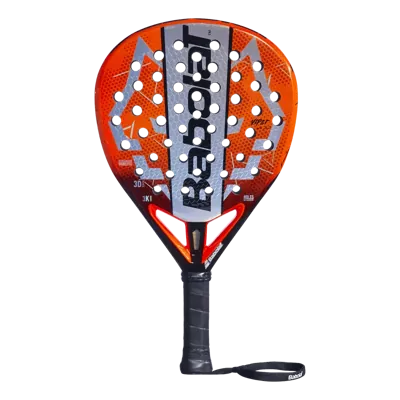
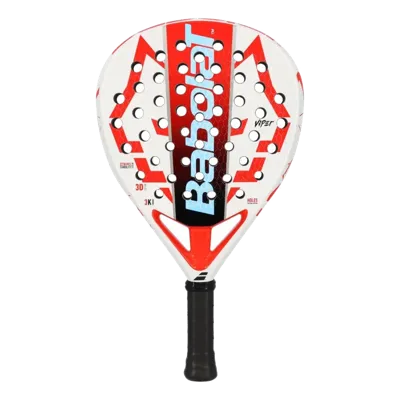
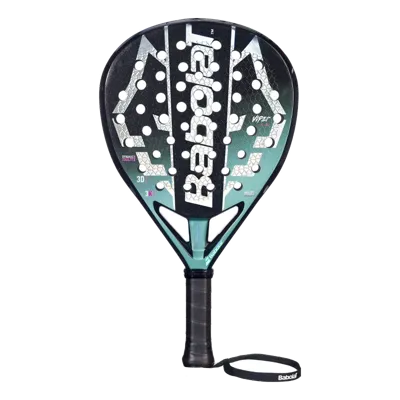
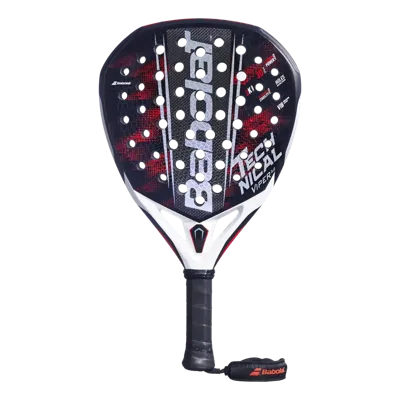
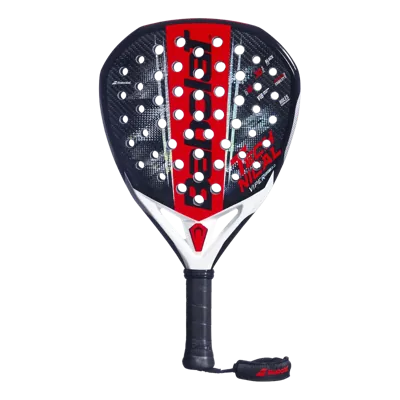
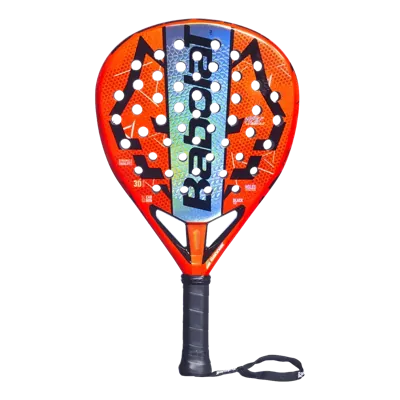
The Babolat Viper Juan Lebrón 3.0 swaps last year's X-EVA core for a Hard EVA core. That one change sets the tone for everything else on the sheet. This is Juan Lebrón's signature diamond for 2026, fixed at 370 g, head-heavy, built from a carbon frame and 3K carbon faces. On paper it points in a single direction: maximum power for an advanced attacker, with comfort and forgiveness traded away. Two independent court tests read it the same way.
X-EVA out, Hard EVA in: the one real change since the 2025 Viper
Compared with the Babolat Viper Juan Lebrón 2025, the core moves from X-EVA to Hard EVA. A harder foam gives more energy back when you swing fully and less help when you do not. That is the trade the 3.0 makes, and it matches what testers report further down.
The surface changed too, from the named 3D Spin+ texture to what Babolat now lists simply as a textured surface. The balance label reads Head Heavy instead of the 2025 label High. Treat that as a relabel, not a measured change. Both labels describe a balance toward the head. Babolat does not publish a balance in millimetres for the 3.0. Face material, shape and weight are unchanged.
370 g fixed, diamond, head-heavy: a spec sheet with a single direction
The published weight range runs from 370 g to 370 g. That is one fixed weight, and it is heavy. Combined with a diamond shape and a head-heavy balance, the mass sits where it helps a smash and where it slows a reaction volley. The frame is carbon, the faces 3K carbon, the profile 38 mm.
Several numbers are simply not published: no balance in millimetres, no head size, no handle specification. Where a brand stays silent you cannot compare, so treat those gaps as unknowns, not as hidden flaws or hidden strengths.
3K carbon over Hard EVA: why power reads High and comfort reads Low
Hard EVA under a 3K carbon face is a stiff, direct construction. On paper it converts a full swing into ball speed instead of absorbing it. That is what the power meter reflects. The cost shows up in the comfort and sweet spot meters, both Low. A hard core absorbs little vibration on off-center hits. At 370 g with the balance toward the head, it loads your wrist and elbow on every defensive stretch.
Babolat lists a vibration reduction system called VIBRABSORB SYSTEM². The product page also credits a Dynamic Stability System in the heart of the racket. That system is claimed to make the frame stiffer and more stable during the hit. Those are the brand's own claims; no independent measurement accompanies them.
Two court tests, same conclusion: overhead power praised, defense exposed
padel.how tested the racket and rated it 73 out of 100. It praised the power ceiling on full overhead swings and stable, direct volleys, and called out defense and low-speed depth as the weak points. Its summary line says defense is the clearest weakness. The German tester Padelvergleich also played it, without a number rating. It landed in the same place. Explosive power and stability, exceptional spin, but demanding and unforgiving for less skilled players.
The two tests disagree on control, one positive and one negative, and on grip. They agree on power, comfort and sweet spot. On the player who will enjoy it they are close but not identical. padel.how names an advanced attacker who prepares early and centers the ball consistently. Padelvergleich speaks more broadly of advanced tournament players seeking maximum offensive power.
3D Spin+ off the face: what the new Textured surface asks of your spin
The 2025 model's face carried a named texture, 3D Spin+. The 3.0 lists only a textured surface. Whether the new finish grips the ball more or less is not measured anywhere. What you have is Padelvergleich's on-court finding that spin is a strength of this racket. Babolat, for its part, claims the reliefs on the face sharpen effects on smashes and viboras. A vibora played with slice still depends mostly on your technique. A texture can add grip at contact; it cannot create spin you do not generate.
The Technical Viper 3.0 and the Soft sibling: same numbers or a kinder arm
The Babolat Technical Viper 3.0 matches this racket on every published spec: same 370 g, diamond, head-heavy, Hard EVA, 3K carbon, 38 mm. That is a remarkable overlap on paper, though nothing beyond the published sheet is documented. There is also a 3.0 FW sibling, again with the same listed specs.
The Babolat Viper Soft Juan Lebrón 3.0 goes the other way. It uses a Black EVA core, a Soft Carbon face and 365 g, five grams lighter. If this racket's profile appeals but your arm has doubts, the Soft keeps the diamond shape and the balance while softening the materials.