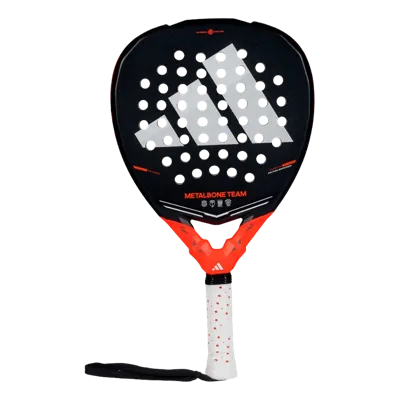
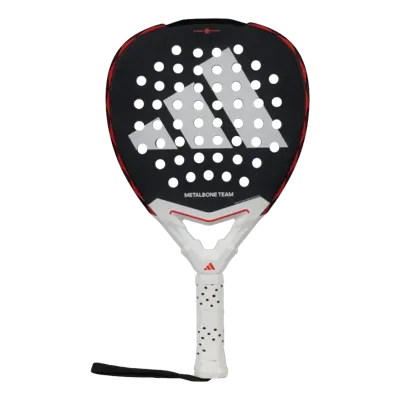
adidas calls the Metalbone Team 2026 a forgiving racket for evolving players. But the meters on this page read low on control, low on maneuverability and low on sweet spot. That is worth reading twice before you decide this is an entry racket.
Forgiving on the label, low on three of five meters
The product page describes stable handling and a confidence-building frame for evolving players. The meters tell a narrower story. Control is low, maneuverability is low, sweet spot is low. Only comfort and power read high. That pattern is not what most players picture when they hear forgiving. It is the pattern of an offensive, head-heavy racket, not a beginner-friendly one.
The same core, different face
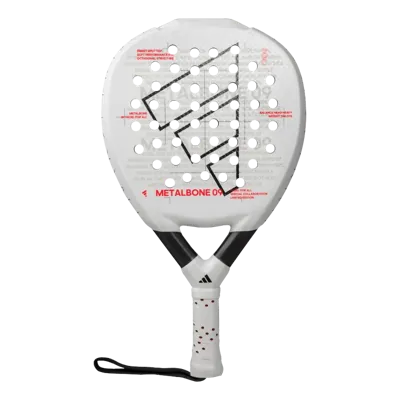
Strip out the marketing language and the construction lines up with the models above it in the range. The core is EVA Soft Performance, the face is fiberglass, the shape is diamond. The adidas Metalbone Carbon 2026 sibling shares the core and the diamond shape. It swaps in a 6K carbon face instead of fiberglass. Its five meters read exactly the same as the Team. The adidas Metalbone 2026 Ale Galán sibling is aimed at a professional level. It shares the diamond shape and head-heavy balance too, but uses a Carbon Aluminized 16K face, not fiberglass. Its weight sits lower, at 345 to 360 g, and its comfort meter reads low instead of high. The Team version is closer in feel to the Carbon 2026 than to a true beginner frame.
360 to 375 g at a head-heavy 265 mm balance
The head is 485 cm2, the frame thickness is 38 mm, and the balance point sits at 265 mm, adidas labels that head heavy. Combined with a weight range of 360 to 375 g, that is mass concentrated toward the top of the frame. On paper that means more weight behind the ball on a smash or a bandeja. It also means less speed getting the racket back in front of you at the net. The handle is listed as an Extra Power Grip, which fits a racket built for hitting through the ball rather than steering it.
A written review and a video review disagree on power
Padelvergleich played the racket and rated it 84 out of 100. It flagged strong power, a forgiving sweet spot and strong comfort. One clear con stood out: the head-heavy balance makes quick net transitions harder. A video review from the channel Dani 13 played it on court. It found the racket comfortable and good for defensive ball output. But it noted the racket feels less manoeuvrable than expected. It also felt lighter on power than other Metalbone models. That contradicts Padelvergleich on power.
Team, Team Light or Carbon: picking your Metalbone
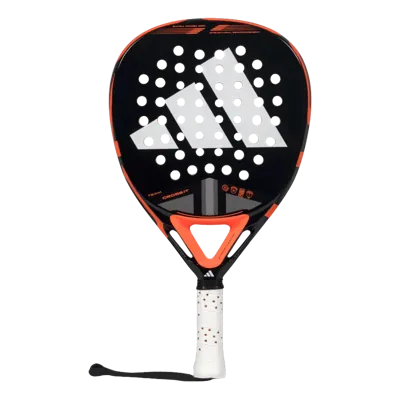
adidas sells several versions carrying the Metalbone name for 2026. Control and an even balance matter more to you than raw power? Look at the adidas Metalbone Ctrl 2026 or its Carbon Ctrl sibling. Both read High on control and Low on power. That is the reverse profile of the Team. If you specifically want to compare this generation against the racket it replaces, see the Metalbone Team 3.4 comparison. For a stiffer face in the same body, the adidas Metalbone Carbon 2026 uses 6K carbon instead of fiberglass with the same meters across the board.