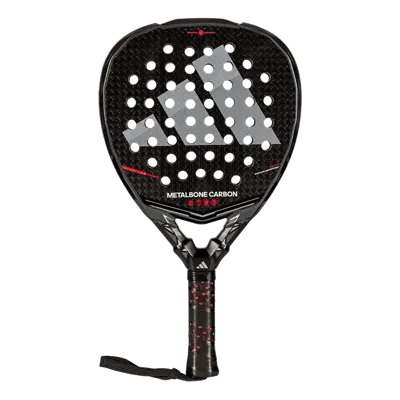
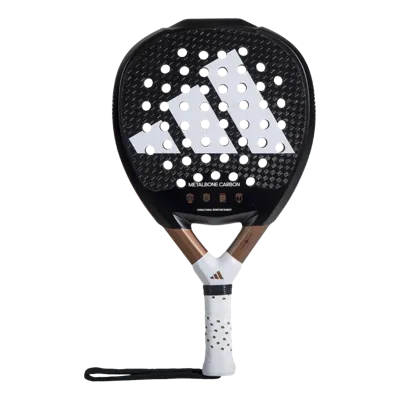
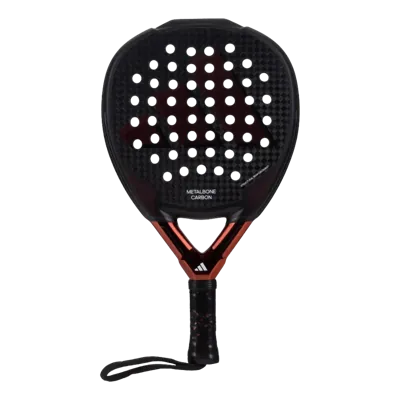
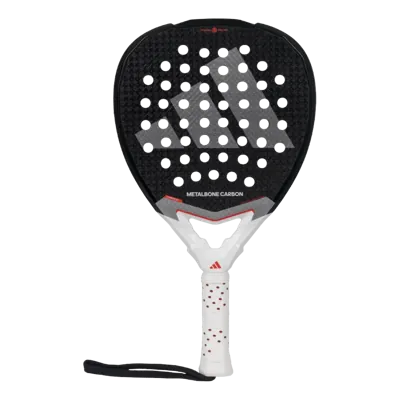
adidas has now sold this racket three seasons in a row. First as the Metalbone Carbon 3.3, then the 3.4, now the Metalbone Carbon 2026. Not a single published spec changed along the way. That matters when you read reviews, because a test of the 3.3 is also a test of this one. What you get is a diamond-shaped, head-heavy racket of 360 to 375 grams, built around a soft EVA core and a 6K carbon face. adidas labels it for professional players.
3.3, 3.4, 2026: three labels, one spec sheet
The Metalbone Carbon 3.3 appeared in 2024 with Pablo Cardona listed as its pro player. The Metalbone Carbon 3.4 followed in 2025, and this 2026 version a year later. Between those three, nothing on the spec sheet moved. Same diamond shape, same EVA Soft Performance core, same 6K carbon face, same 360 to 375 gram weight range, same 38 mm profile.
The only change in the line's history sits earlier. Between the original 2023 Metalbone Carbon and the 3.3, the surface finish went from Spin Blade Mold to Spin Blade Decal. That is a changed label for the rough layer, not a measured change in how it plays. So treat every court test of the 3.3 and 3.4 as a test of the racket on this page.
Diamond and head-heavy, but with a soft EVA core
Most diamond rackets pair the shape with a hard core. This one does not. The shape and the head-heavy balance push weight toward the top, which helps you accelerate through smashes and bandejas. The soft EVA Soft Performance core gives the ball an easy exit at lower swing speeds. Defending deep balls takes less effort than with a hard diamond. The 6K carbon face is a mid-stiffness carbon weave, softer than the aluminized 16K carbon adidas puts on the Metalbone 2026 Ale Galán.
A retailer lists the balance at 265 mm, which is moderate for a diamond. adidas itself rates the racket 9.5 out of 10 for power and 8.5 out of 10 for control, the brand's own numbers. The head measures 485 cm2, the profile is 38 mm and the length 455 mm. adidas also claims an octagonal frame section reduces torsion for more precise shots, and that the polyhedral frame design adds stiffness and power. Those are brand claims, not measurements.
Forgiving for intermediates or demanding for advanced players: the tests split
padel.fyi actually played the identical 3.3 and rated it 7.4 out of 10. They call it a medium-hard racket for intermediate players. Easy to swing, little arm fatigue. Their one real complaint was control at the net, where the soft core's trampoline effect made the ball jump off the face.
The video reviewers, who also played it, lean the other way. Padel Review calls it one of the most powerful rackets in the adidas range. Suited to advanced players on the left side, and hard to control from the back. Dani 13 found a dry, stiff feel with strong control in attack, but an inconsistent response when you miss the middle. Fabio Ferro landed in between. Comfortable and gentle on the arm, in his view the most balanced racket in the Metalbone line. He noted a slightly small sweet spot and a rigid tip.
Padelzoom's ratings come out positive on power, control and sweet spot, with 8.4 out of 10 for the identical 3.4.
So who is right? Probably both. A soft diamond rewards timing. If your technique is clean, it plays friendly. If it is not, the small sweet spot exposes you.
What the meters say against what padel.fyi played
On specs alone this racket reads harsher than the court tests suggest. The heavy weight class, the diamond shape and the head-heavy label point to low control, low maneuverability and a small sweet spot. That is exactly what the meters on this page show.
padel.fyi's on-court test tells a different story on handling: they found it moved easily and tired the arm little. Fabio Ferro said much the same in his video. The listed balance of 265 mm helps explain why. That is moderate for a diamond, so the head weight is less extreme than the label suggests. When sources disagree like this, trust the people who swung it.
The soft diamond among hard Metalbones
Within the 2026 Metalbone family this is the comfortable attacking option. The Metalbone 2026 Ale Galán uses aluminized 16K carbon, comes in lighter at 345 to 360 grams and rates low on comfort. The Metalbone HRD+ 2026 goes further with a hard EVA High Memory core. A video review by Keepadel, which tested the Carbon against the regular Metalbone, also notes this racket lacks the adjustable weight and balance system of its sibling, and that the 6K face plays drier and more controlled.
If you like the soft core but want control first, the Metalbone Carbon Ctrl 2026 keeps the same foam and face in a round shape with an even balance. Same recipe, opposite priority.